Let’s talk about Personal Calendar.
Earlier this month, Valve raised the requirements to appear in Popular Upcoming from 7,000-ish wishlists to somewhere around 100,000 wishlists.
In Valve’s words
“The contents of this tab have been updated in response to player feedback in order to better capture the most anticipated releases of the coming month.
Steamworks Blog – Please read the official blog post about it here
This of course did not go over well with the indie community.
Then, Valve suprised us with a new widget called Personal Calendar that gives you more time on the front page of Steam and by extension more wishlists before launch. Please read the official Steamworks blog post about Personal Calendar.
It turns out Personal Calendar is great and an incredibly positive boost for indie game devs and is a welcome addition. The whiplash of all these algorithm changes triggered the 3-stages-of-algorithm-grief-acceptance that circulate among indie game dev communities.
Let me explain….
The 3 stages of algorithm grief
 | Stage 1 | Valve has raised the requirement Popular Upcoming?!? 7000 wishlists is no longer the target, I need 100,000 wishlists?!?! My career is over. Indie games are over. This industry is over. |
 | Stage 2 | Wait, Personalized Calendar is earning tons of wishlists for indies? It is actually better than Popular Upcoming? Good stuff is happening! I feel confident. I am happy. I am in control of my life. I am optimistic and hopeful. |
| Stage 3 | Well, indies earning thousands of wishlists from Personal Calendar is probably a short lived blip from shoppers just trying it out for the first time and when the novelty wears off they will stop using it. Other indies are probably already exploiting it. I’m guessing its only good for games with low wishlists and no marketing (despite having done no research into the matter). Obviously will lead to wishlist inflation. The wishlists earned from personal calendars will likely convert poorly. Obviously once Valve realizes that it is helpful, they will Nerf it. Obviously! This isn’t sustainable because…AI Slop? This only works for non-saturated genre and the discovery is now even worse for unique games. Survivorship bias much? |
Please, indie devs, I beg you, do not proceed to Stage 3. You can just stay in Stage 2 and enjoy your life. You don’t have to go on Reddit or make Youtube Videos. It isn’t good for you. Please.
A bunch of thoughts about the Personal Calendar
Here are some thoughts to keep you in Stage 2.
It seems good!
Here is a roundup of people sharing their numbers once their game got on Personal Calendar
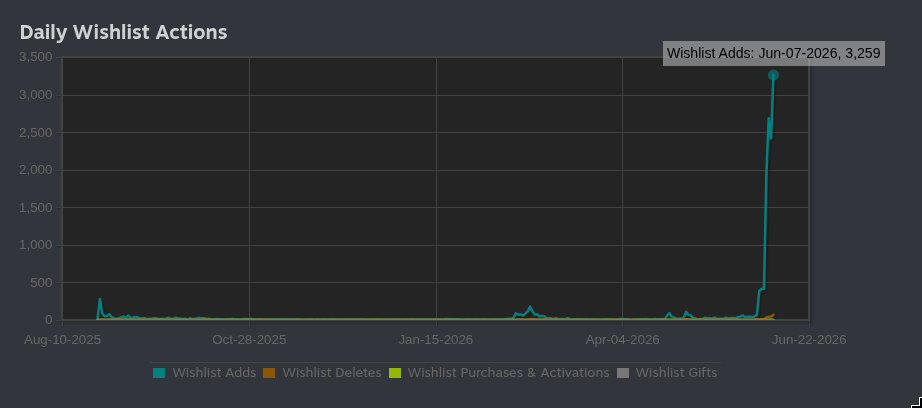
The developer of Don’t Let It Starve X post (Steam Link) told me that he went into the launch window with 5,930 wishlists but when the Calendar boosted his wishlists up to 11,630.
In the old days, Popular upcoming would earn your game about 1000 wishlists per day. At best you could get 1 or 2 days on the list.
Now we are seeing 300-3000/day for the personalized calendar AND it can last for 2 months before launch AND a month after launch.
Look at this wishlist chart for Don’t Let It Starve after getting into the Personal Calendar
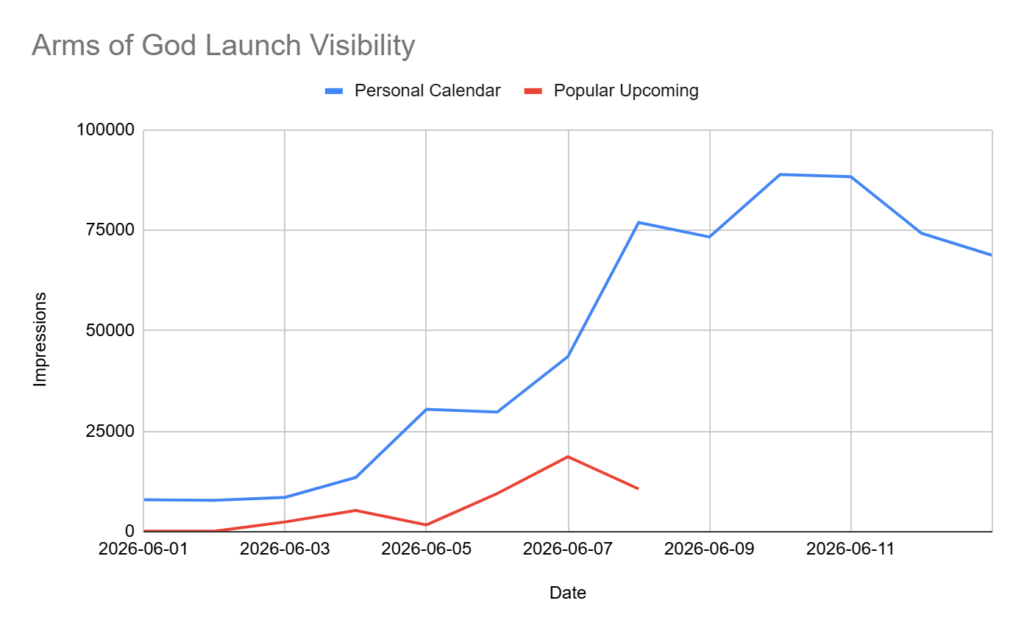
The game Arms of God launched on June 8th right when the Personal Calendar was being deployed. So they simultaneously saw traffic from Popular Upcoming (red) and Personal Calendar (blue).
The red line stops on June 7th because once you launch you are kicked off Popular Upcoming. Personal Calendar gives you visibility for another month after launch. It is awesome!
The meta has not changed: How to get into the Personal Calendar
The meta for launching a game isn’t meaningly different in a post-Personal-Calendar world.
The reason indies were always stressing about 7000 wishlists was because that typically ensured you would show up in Popular Upcoming (PU). I wrote about that here. Unfortunately you still have to get around 7000 wishlists (more on that in a second).
Basically PU was the first step up the ladder of Steam visibility. If you didn’t get enough for PU, it was increasingly hard to get the next step (New & Trending) and then the next step up and so on.
Now Personal Calendar replaced PU as the first step of the visibility ladder. But, unfortunately, Personal Calendar also has a minimum bar of entry (again, more on that in a second).
So essentially the meta has not changed since the underlying goal is the same. You need a bunch of wishlists before you launch so the algorithm pushes you to more people.
- You still need to get your page up nice and early,
- You still need to try to get as many wishlists as you can.
- You should still get a demo out ASAP and reach out to content creators and apply to festivals.
- No, momentum is not more important now.
- PLEASE PLEASE PLEASE do not shadow drop your game.
If anything you need to keep your Steam page up longer in the new world because Personal Calendar has a 2 month pre-launch window of visibility which essentially encourages 2 months more of just hanging out on Steam.
Side note: I will be updating my course, but the core strategies are still the same, it is just the mechanisms have changed a bit from Popular Upcoming to Personal Calendar.
The target number is not as clear
To appear on Personal Calendar, my early analysis says you need somewhere between 8000-30,000 wishlists.
But the TL;DR is: When I set my own Personal Calendar to the default filter of 100 games and then polled how many followers each game had. This was the result:

The follower counts of games that appeared on MY Personal Calendar:
- 30th percentile was 804 followers or around 8000 wishlists
- Median was 2800 followers or about 28,000 wishlists
- 70th percentile was 6600 followers or 66,000 wishlists.
For more details check the benchmarks page.
Raw exposure isn’t the goal, quality impressions are
Indies always want “exposure”, or “visibility.” But raw visibility to everyone on Steam is worthless. Gamers really have a preference about genres they like and those they don’t. You are not trying to convince someone to like your game. You don’t hard sell them. You don’t trick them into liking your game. Instead you are trying to find the people who are predisposed to liking your game and proving to them that your game matches their tastes.
The developer of the game Focus Grove launched his game right around the debut of the transition from Popular Upcoming -> Personal Calendar and sent me his game’s data.
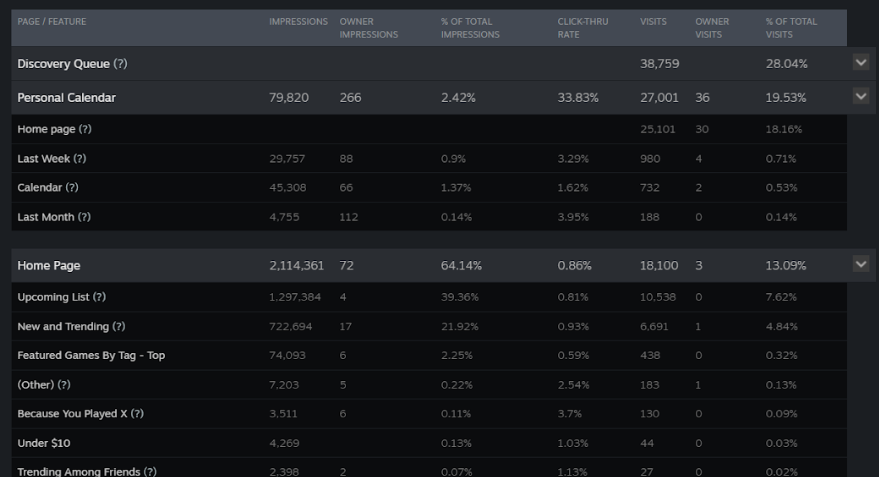
Pay attention to impressions vs click through rates for these widgets. Let me call them out here for Focus Grove:
| Source | Impression | Click through rate | Visits |
| Popular Upcoming | 1,297,384 | 0.81% | 10,538 |
| Personal Calendar | 79,820 | 33.83% | 27,001 |
Notice how the personal Calendar doesn’t generate as many impressions but it gets better results.
Another developer from Starforged Legacy shared similar numbers with me:
| Source | Impression | Click through rate | Visits |
| Popular Upcoming | 704,226 | 1.56% | 10,985 |
| Personal Calendar | 105,413 | 31.26% | 32,952 |
If you look just at the impressions, the change in widgets looks catastrophic. But in reality, the visibility is more efficient now and the actual visits is very much improved.
Indies should not try to make a game for everyone. We are too small. We are artisanal toy makers for a discerning audience.
Valve’s is on an ongoing quest to personalize the store
The main (non-infinite-scroll) section of the front page of Steam has room for about 200 games.
But more and more games are launching every day. So, how does Valve give more visibility? By increasing the surface area of the store by customizing what games are shown to the user.
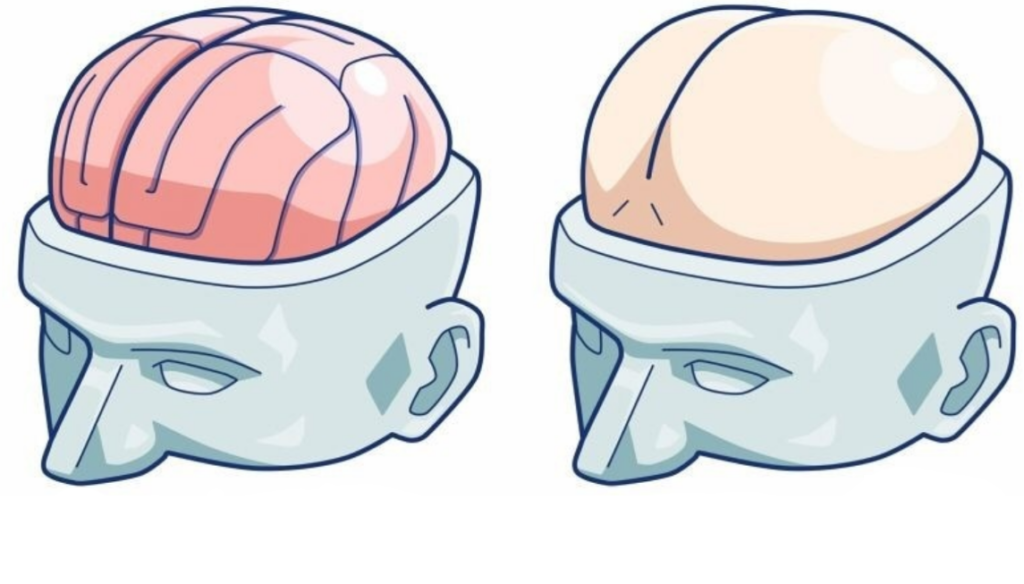
A non-personalized store is like a smooth brain. A personalized store is textured, wrinkly brain that can fit in more games in the same volume due to increased surface area. (image credit I think)
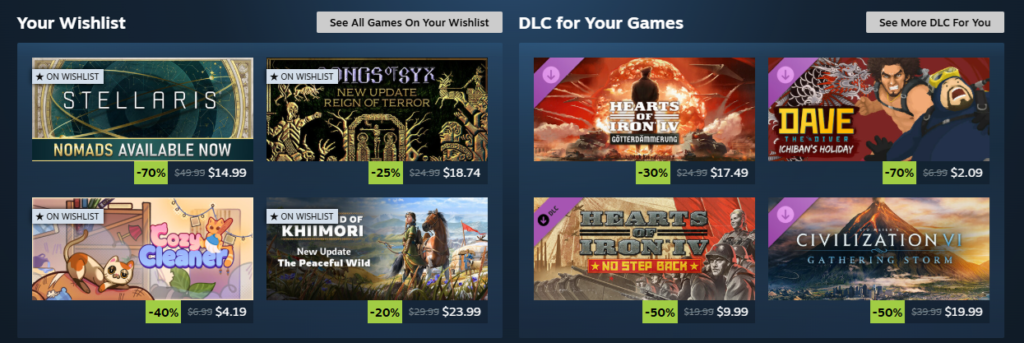
This is the broader Steam strategy: every time Valve has updated a major widget, they have made it more personalized and less universal. Look at the front page of steam. At the top is more games shown from MY wishlists or DLC for games I own.
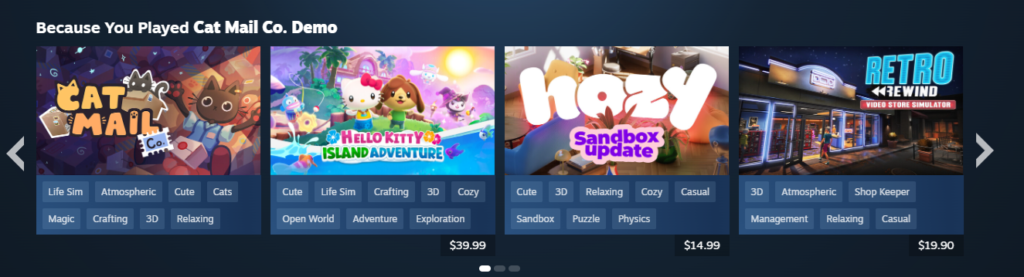
Or recommendations based on what I recently played

Similarly Discovery Queue is personalized.
I have even heard that the Daily Deal section is moving to be more personalized.
The way Valve is handling more games on the store is to filter out stuff that each individual player doesn’t want.
The Personal Calendar is another example of this.
You must look like your genre
If a personalized store front is the future, you do not want to look like a game that could appeal to anyone. Instead, at a glance your game must say, “I AM THIS GENRE, STAY AWAY NON FANS”
You do not want to be a game for “casual players” who don’t play very often and don’t even know their favorite genre. You want to make your game speak the exact shibboleths that the super fans understand.
You need to make a hyper specific game for a very specific audience that knows the genre. You must lean into your genre tropes. GENRE GENRE GENRE.
Early Access & Full Release
Right now it looks like Early access (EA) -> 1.0 transition games are showing up in the Calendar.
Previously, in the world of Early Early access games, Popular Upcoming was only for EA first launch
New & Trending was only for EA->1.0 launch
But the calendar is showing games in both stages of release. That is good for EA games. Theoretically an EA game could spend 6 months on the Personal Calendar. That is a bit of extra visibility that EA games over traditional full launch games.
HOWEVER, I still don’t think the Personal Calendar is a reason to make an EA instead of a simple traditional full launch. I still don’t think most people should do EA (especially for their first game).
Popular upcoming is still useful
This is a screenshot of popular upcoming I took on June 24th in a post-algorithm change world. Look at all those indie games there.
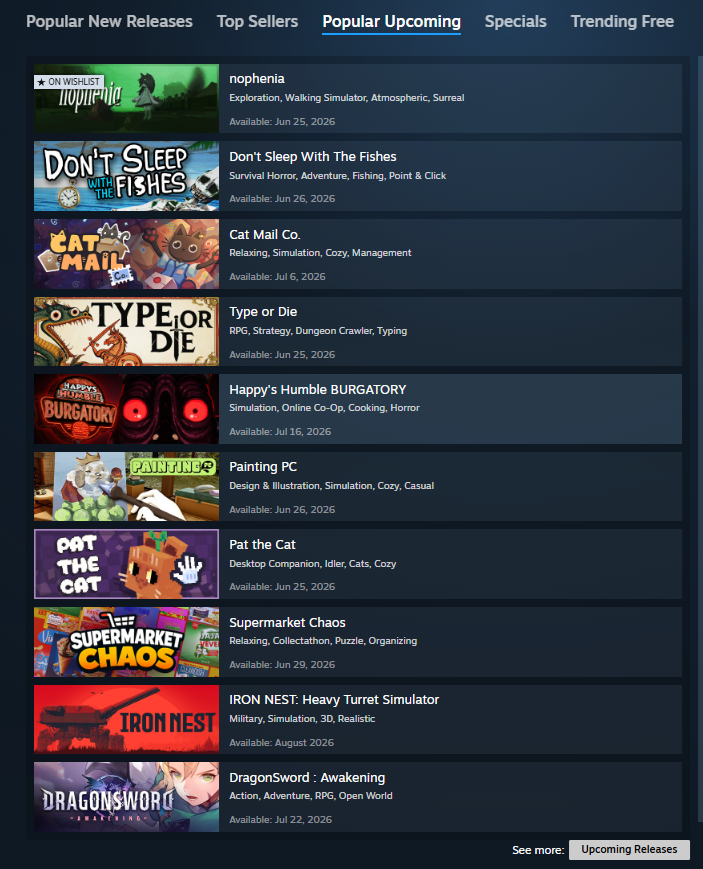
Here is their follower count of the games in that chart:
| Game | Follower Count |
| nophenia | 2574 |
| Don’t Sleep With The Fishes | 961 |
| Cat Mail Co. | 1,326 (note this game is showing up 1.5 weeks before launch, That is forever in PU time!) |
| Type or Die | 1,328 |
| Happy’s Humble BURGATORY | 1,745 (3 weeks before launch) |
| Painting PC | 535 |
| Pat the Cat | 581 |
| Supermarket Chaos | 560 |
| IRON NEST: Heavy Turret Simulator | 32,312 (2 MONTHS before launch) |
| DragonSword : Awakening | 13,263 |
Notice that some of the games on the list have 581 followers which translates to about 6000 wishlists. You can still get on PU with low wishlist counts. The bonus change is, if you have huge follower counts you can spend weeks on the front page like IRON NEST, and Happy’s Humble BURGATORY.
I have a script that scrapes the popular upcoming charts every day to see how many games appear on it and for how long.
Here is a chart I built from the scrape data showing May (on left) and June (on right). Notice how the number of games added to the list every day dropped from 10/day to 1-3/day.
The line graph in the lower half of the chart shows the duration every game spends on PU. Look at how the days on PU have increased dramatically. (Side note, some of this sample data comes during Steam Next Fest when fewer games launch, so games stay longer because fewer games are pushing old games off of PU).
Valve turns developer hacks into legitimate widgets
The Personal Calendar is a classic Valve Move.
Valve watches what we developers do. When we exploit a small advantage and push a widget further than it was supposed to, Valve often shuts down it but creates a new tool that does the same thing but better.
History of Valve Widgets that came from developer hacks:
- Devs used to download thousands of free steam keys to run betas. Valve stopped giving thousands of keys away and instead added the playtest button feature.
- Devs used the prologue trick to get lots of visibility on a demo version of their game. Valve turned around and gave demos more visibility by added the “Trending Free” tab and “Email Wishlisters” demo launch button.
The Personal Calendar is the latest example of this trend.
Developers were over-optimizing their launch day to get as much time on the front page via Popular Upcoming. Essentially we were trying to treat the 10 slot PU like a calendar.
Instead, Valve looked past what we were doing and evaluated what we were TRYING to do and created a widget to better accomplish our goals.
I give full credit to Valve product managers on this. This is a sign of good UX and product management (I know because I used to be one before I quit my day job to became a game marketing blogger). This is good work.
Developers are not setting their release date early enough!
Look back at the May/June Popular Upcoming Change chart above. You can see that about 10 games hit PU every single day. That was stiff competition.
I went to my Personal Calendar, bumped up the filtering to show 250 games and I can see that in July and August there are only about 1-2 games showing up in each day.
I know it is personalized so stuff I wouldn’t like is filtered out, but still there aren’t that many games showing up in my calendar. I would expect 5-6 games every day. What gives?
My hunch is that most devs don’t set their release date until they are 100% sure their game is ready to launch. Most indie devs are flying by the seat of their pants so they only know that they are 100%-ready-to-launch about 2-3 weeks before.
THIS IS A HUGE MISSED OPPORTUNITY.
You should be setting your release date 2 months in advance so you can spend more time on the calendar.
Look at how few games are showing up in this calendar. I suspect devs are not setting their release date:
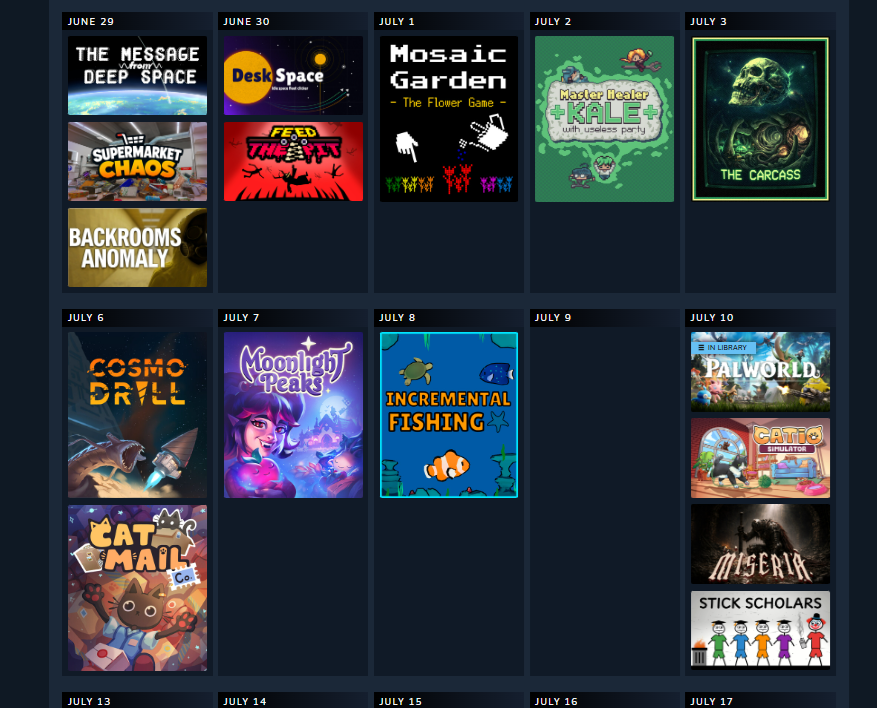
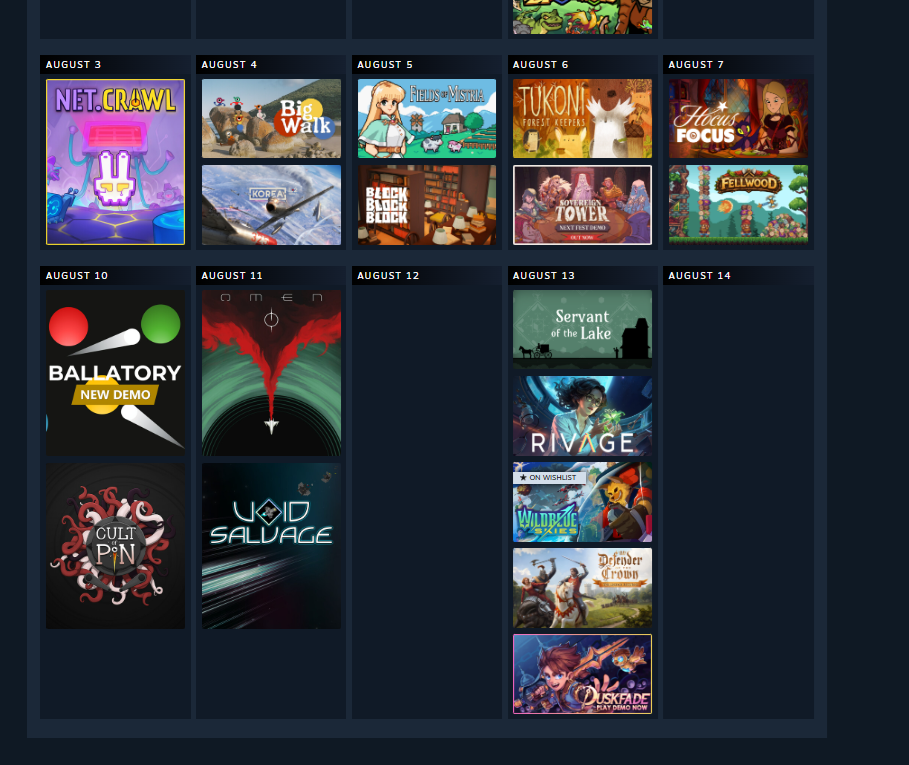
So, either get better at game production where you feel confident about your launch potential 2 months in advance. OR, when your game is 100% complete, then set a 2 month promotional window so you can really market this game down the home stretch and maximize your time on Personal Calendar.
What the future run up to launch will look like
This final 2-month window is the biggest “Meta” change I see caused by this new widget
Here are the facts:
- The Personalized Calendar gives a lot of targeted traffic.
- Your game can start appearing in it 2 months before launch
- It is personalized using woo-woo algorithm stuff to match your game to players’ personal choices
- The Valve team wrote in their blog post “Refreshed daily: This recommendation system gets re-trained daily to incorporate the latest data. In reality you aren’t likely to see your recommendations change all that much from day to day, but as time goes by you will obviously see new things pop up as the 8-week horizon of the calendar marches forward, or as games lock in their release dates.”
Therefore your run up to launch will not be a binary on popular upcoming or off popular upcoming. Instead, the 2 month run up will involve a lot of tuning and increased but unpredictable wishlist counts.
All the following is conjecture (I don’t know how the algorithm for the calendar works) so don’t quote me on Reddit or use me in some stupid discord argument. But this is how I think this will change:
- You should definitely set your date 2 months before launch. AND STICK TO IT.
- You should be testing different capsules that better show off your genre at a glance and visually stand out among hundreds of other capsules. Yellow borders?
- You should be moving around tags weekly to see what combination makes you show up in more personalized calendars.
- You should do more targeted marketing pushes throught the 2 months to content creators and festivals so that you get more wishlists which MIGHT signal to Valve that your game is worth showing more in the calendar.
- As your game gains more wishlists in the home stretch there MIGHT be thresholds where the calendar starts showing more.
DONT QUOTE ME on that list. This is still so new and we don’t have many test cases. I don’t know if quick increases in momentum will actually make you show up in more calendars. But in my experience with Steam algorithms, they like to see bursts of wishlists as a signal that your game has something worth promoting. This is gut feel on my part. I just am saying to keep an eye out.
Again I don’t know how it will work. All I can say is in your last two months should involve a lot of monitoring and testing.
Please for the love of God don’t shadow drop your game
I am working on a separate blog post on the dangers of Shadow Dropping, but nothing is more maddening and saddening to me than when indie devs think they can just suprise announce a new game and launch it days later. Why? WHY? WHY?!!!?!!?
Shadow dropping is not cool. It is not smart.
Did you know there was a Sequel to the hit Fights in Tight Spaces that was shadowdropped on June 7th. I didn’t know about it because Shadow dropping is a terrible idea that hurts your visibility!

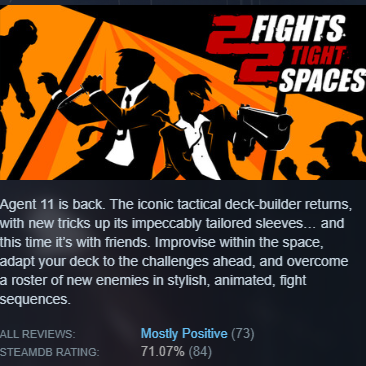
If the developers of Fights in Tight Spaces couldn’t shadow drop a game and make it work, neither can you.
You are paying Valve 30% of your game’s revenue so you have access to tools like Personal Calendar. By shadow dropping your game you are purposely not using the tools that you are paying for. Why why? WHY!?!!??
I don’t care if you have a youtube channel with 100,000 subscribers. Don’t shadow drop your game.
The Personal Calendar is another tool that benefits long slow marketing periods where your game slowly gains wishlists. No surprises. No shadow drops.
I know long marketing campaigns are boring and cringe, but that is what works. I am sorry.
Yes the course will be updated
I am running a sale in July. Join the mailing list to find out when.
I will update the course with the new strategy for this tool. HOWEVER, I need to wait to get more data to see how this all works. These are just theories.
It will not be updated in time for the sale. But I promise it will be eventually. When you buy my course you have all future updates for life. You do not need to rebuy the course for every version (I am already up to 3.0).