If you look at the raw numbers, it seems like demos do not directly lead to wishlists. But demos are still the most powerful marketing tool for generating wishlists. Wait? What?
Demo play stats are one of those weird paradoxes you have to wrap your mind around when you are marketing on Steam. In today’s blog post I am going to explain one of the weirdest metrics Valve shows you if you participated in Steam Next Fest.
Your demo isn’t actually for fans.
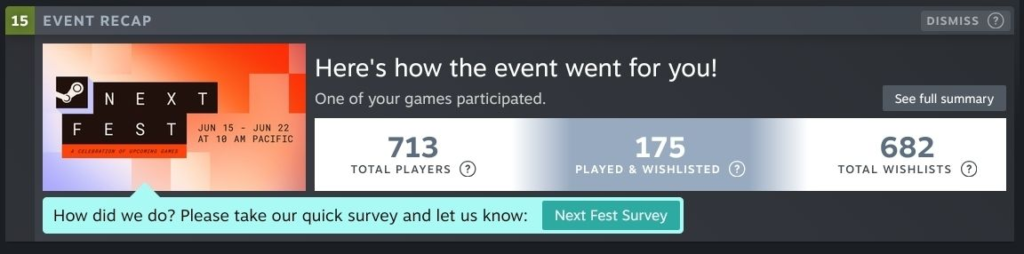
Here is how Valve shows it after you participate in Steam Next Fest:
Let me just visualize this for you. If you take every game in my survey and do this:
(Total Wishlists) - (Total number of players) = DifferenceYou get a chart like this:
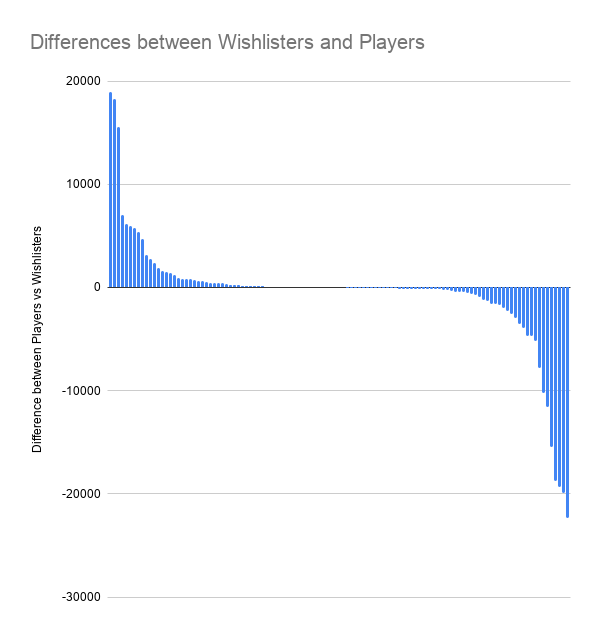
That deeply negative dive on the right side of the chart shows that for the most part, people will play the demo, and never wishlist it.
There is a full range of experiences for games:
From nearly symetrical
to some other games that have even more lopsided play/wishlist stats:
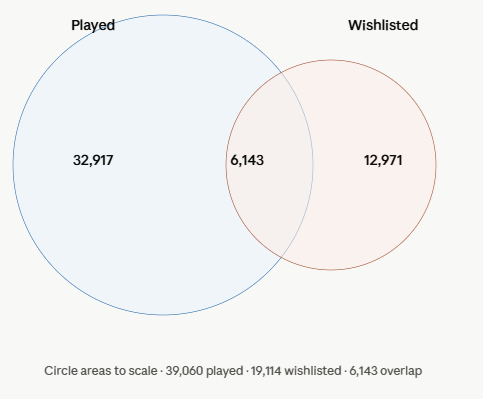
To being lopsided on the other side
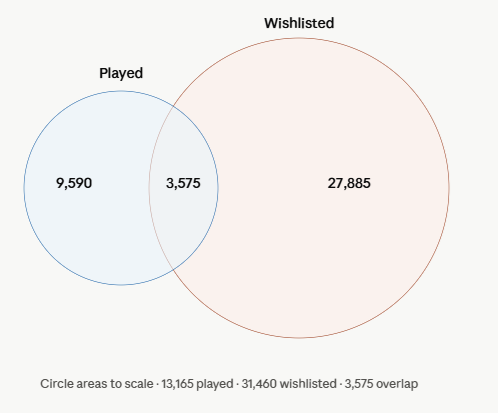
But in all cases, the overlap is very very small comparatively.
Steam Next Fest metrics
If you look at the first image 713 people played that game’s demo during Next Fest. Of those 713, only 175 wishlisted it after playing it. That means only 24.5% of players stuck with the demo and bothered wishlisting it.
At first glance, that seems dishearteningly low. 75% of people essentially played the game and then said “Nah, I don’t want anything to do with this from now on.”
A lot of developers feel self-conscious after seeing this number. But they shouldn’t be.
24.5% play & wishlist is actually HIGH!
Here is a histogram chart of everyone who gave me their Total Player data from the June 2026 Steam Next Fest:
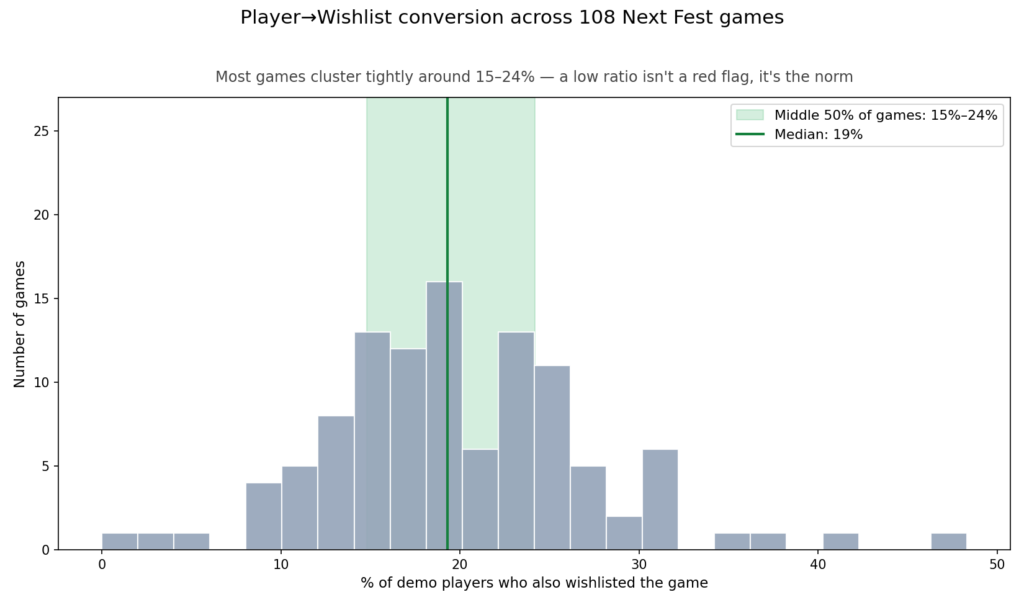
| Percentage of players who went on to wishlist the game after playing the demo | |
| 30th percentile: | 15.9% |
| Median (50th): | 19.3% |
| 70th percentile: | 23.2% |
Steam makes no sense! Don’t trust your gut!
I don’t even think you can draw conclusions if your game did better or worse than the median game. Don’t try to over analyze this.
Here is a scatter plot of how many wishlists the games earned during Steam Next Fest mapped against their demo to wishlist conversion %.
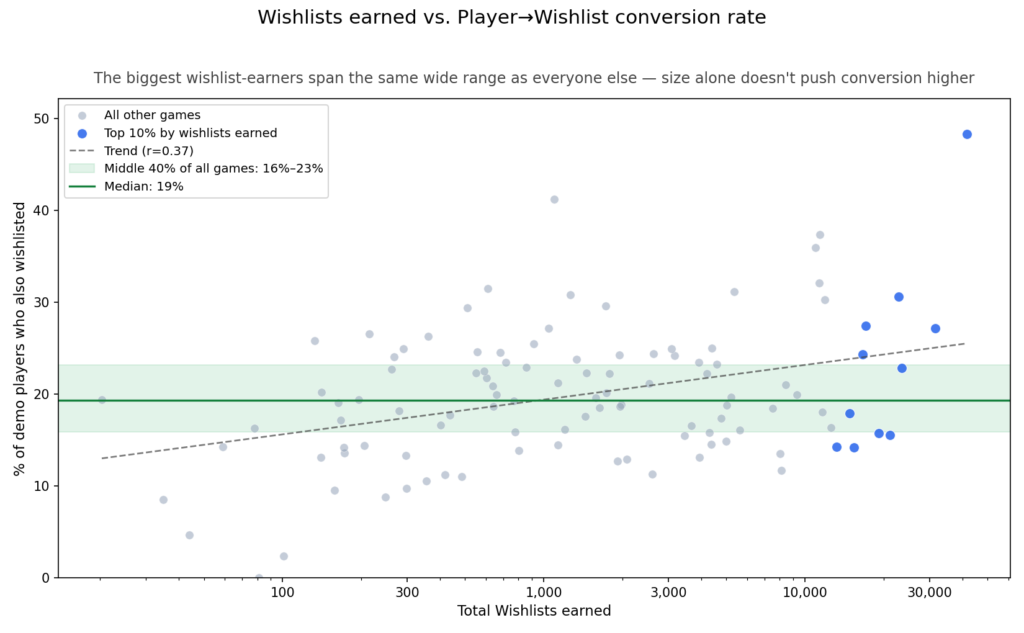
Every dot is a game. The further to the right the game is, the more wishlists it earned during SNF. You want to be on the right side of the graph.
Look at those dark blue dots on the right. There are a few games that earned over 15,000 wishlists yet were below a 15% conversion rate. Similarly, there were games that only earned 1,000 wishlists and had a 30% conversion rate.
Yes, the trendline of conversion % points slightly up towards the highest performing games but not by much.
Do not over analyze or feel bad about your conversion rate.
You can’t bring funnel logic to Steam
I love talking about Marketing Funnels (I did a whole GDC talk about them), BUT, you cannot apply them to behavior within the Steam Algorithm.
Within Steam, people do not follow a logical linear consumer behavior of:
- Being interested in a game
- Downloading and playing the demo
- Evaluating it on its merits
- Wishlisting it after it satisfies their 5 point heuristic of what makes a game good to them
NOPE!
Many people who are very, very excited about your game DON’T want to play your demo because they want to wait until the full release so they aren’t spoiled.
Also, you do not “burn out” your players. They do not get “tired” of you. You cannot over-expose your game because they aren’t even playing the demo.
So why do you even need to make a demo?
You need to make a demo because absolute gaming sickos exist. Let me explain….
Note: I will be honest, this is a theory. I don’t have concrete proof of this. Any numbers I state here are totally made up. I don’t know how I would prove it. But this is a theory I developed after interviewing dozens of random Steam players for my GDC talk Empathizing With Steam. It also comes from watching how games take off after launch.
Note: I call them Sickos as a joke. They are very lovely people and they are the reason why indie games have any visibility at all. But they are kind of nuts.
Basically, there is a very small percentage of Steam’s 100,000,000+ player base that plays EVERY GAME. They don’t care how crappy it looks, if it has asset-store art, if it is missing a trailer, if it has a 5-minute trailer that is 75% lore dump cut-scene trailer. They play it. It might not even be their favorite genre. They play it.
They are trying to be the person who says “I played Balatro before anyone else heard about it.”
You are making a demo for them.
The reason most of people play your demo and don’t wishlist it is because I really think the Sickos are like “I know this says it is a tower defense game, but maybe it is actually a roguelike, I better play this demo just to make sure.” And most of the time they are like “Yup, it is a tower defense, I don’t like it… moving on.”
These Sickos are the equivalent of a person going to a buffet and loading up on one of everything (even if they don’t like that food.)
They are brave enough to give it a shot.
More visibility = More sickos
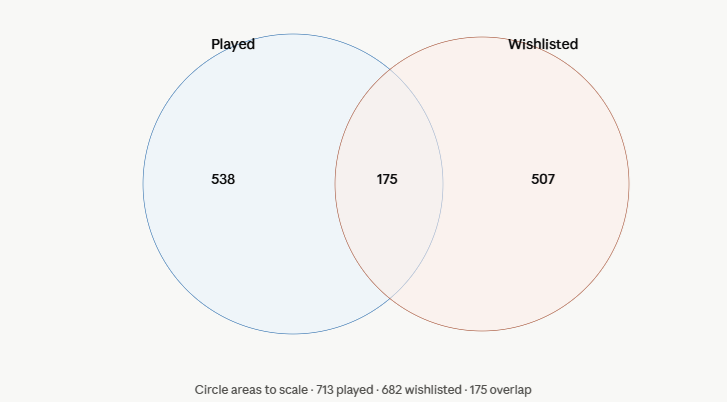
Remember these Venn diagrams at the top.
This one belongs to the game Trash Day which was the 37th most played demo during the festival:
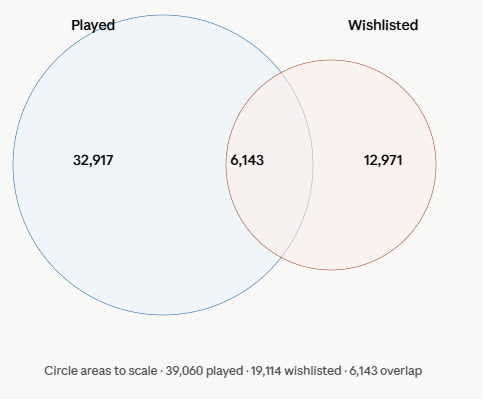
It looks lopsided. It might seem like this is bad and you need to do something to fix it. These games are high wishlist earning, and very popular. These are the games that have the visibility that developers yearn for. They were featured in the top charts at SNF. Lots of Sickos saw the game there and gave it a try.
Do not make gameplay changes based on this data. If your played/wishlisted charts look like this, don’t go back to your team and say “We gotta fix our tutorial! Look at how many people played and didn’t wishlist.”
NOPE!
It is just Sickos trying out your game to make sure they tried every game in SNF.
RELAX!
Sickos enable word of mouth
These Sickos get a special joy out of being the person who tells their friends what games to play. They are the tip of the spear. They are the person who dives into the muck to find the gem.
Sometimes the Sicko falls in love with your demo. Plays it repeatedly. Then their non-Sicko friends will see that Steam popup:

The friend will think: “That Sicko has been playing that game every night this week. If they are doing that, that must be a really good game, let me check it out.”
That’s word of mouth.
Also content creators are Sickos
Content creators who play demos to their audience on YouTube or Twitch or clips on TikTok are also Sickos. They are looking for games that they know their subscribers / followers will want to watch. So they are ripping through demos at a quick pace making judgments within minutes. They only wishlist the ones that they think will make good content.
You probably aren’t a Sicko
Any time I write about a marketing phenomenon or behavior like Mailing Lists, Discovery Queues, or Demos there is always some guy who says “Well I don’t use the Discovery Queue” or “Well I never play demos, are you sure I need to make one?” or “Well I don’t subscribe to any mailing lists, do I really need to have one?”
Well, every gamer is different and congratulations you are not a Sicko.
You are a developer. You don’t have time to dumpster dive through Steam. You might be the type of gamer who only plays well known AAA games, or someone who relies on recommendations from friends. Or you might be a developer who hasn’t played games since 2007. I don’t judge.
I really don’t like the marketing advice of “Just practice honest marketing… Simply ask yourself how you would like to be marketed to and just do that.”
That isn’t enough. There are some very important, but very small audiences who are quite different from how typical players consume games. You must learn how they work, empathize with them, and show them your game in the way they want to be marketed to.
Yes you need to make a demo
Even though most people will play your demo and not wishlist it, you must make a demo because the ones who do, are very influential. Demos enable the possibility to be found by the most potent fan on Steam who are worth more than 1 wishlist or 1 purchase. They enable dozens, or even thousands (in the case of content creators).
As an indie on Steam, you don’t actually market to fans.
You market to Sickos and then if they like you, they market your game to their friends, followers, and fans.