SUMMER SALE BLOG MARATHON: This is the last week of my course summer sale. To celebrate this deal, I am writing a blog post every day in countdown. I have never discounted my everything bundle this low. EVERY SINGLE COURSE I have released in the past is now cheaper than buying just one course when off sale.
On with the blog…
There were more games in the June 2026 Steam Next Fest (SNF) than ever in recorded history (4000+). There were also LOTS of complaints about AI slop, and a cry that everything has changed.
The data doesn’t quite say the same thing.
Like most previous Steam Next Fests, I again ran a survey of participants using my new SNF tracking tool. I got 119 responses. The survey tool is still live here if you had a game in the June SNF (howtomarketagame.com/snf)
What did I learn from the data?
- The AI slop actually didn’t hurt most developers, in fact, “middle class” games did better in June SNF than February SNF!
- Small games going into SNF with <1000 wishlists were hurt and seemed to be drowned out in the SLOP pile.
- Statistically, success is SLIGHTLY more correlated with games that had good “Momentum” than lots of wishlists.
- There is no evidence of regular steam players getting “scared off” by the first 2 days of slop
Let’s dive in.
Slop didn’t stop the fun
Wishlists Earned During SNF, by Pre-Fest Wishlist Bucket
Here is a graph of how games performed bucketed into how many wishlists they had going into Steam Next Fest.
As you can see, for all buckets above 1000 wishlists, the median game did better in June than they did in February 2026.
Despite more games and (based on the people complaining) more slop, the median wishlists earned was more for every bucket above 1000.
I think Steam’s algorithms were tuned up to smother the slop and so games with low wishlist counts were pulled down too. There were even a few games in the sub 1000 bucket that escaped the slop and went on to earn 13K wishlists during the fest.
I also added the February 2025 numbers which were the strongest I have seen in all my years documenting Steam Next Fest, it was the first year of the machine learning 2-day random exposure. As you can see, as the algorithm has evolved it has shifted traffic away from bottom tier and top tier games. The middle-class games were the ones least impacted by the huge increase in participating games. Yes the median is slightly lower between Feb 2025 and June 2026 (1.2K vs 1.5K) but it’s not a disaster. Steam Next Fest is still a great way to get a lot of wishlists provided you play the marketing right.
I know everyone was super doom-and-gloom regarding the amount of slop, but it really doesn’t seem to have impacted the performance for most games. I really think Valve is using player behavior to determine what to hide after the first 2 days. Players really don’t like slop.
Momentum is slightly more predictive of success
When I say “Momentum” or “Velocity” I am referring to how many wishlists a game earned in the 2 weeks before SNF. Don’t obsess about why I picked 2 weeks. There is nowhere in the algo that looks at that. I just picked it as a somewhat arbitrary heuristic for a time period before SNF starts.
So, for example, a game that earned 2000 wishlists in the 2 weeks before SNF has more momentum than a game that earned 100 wishlists during the same period.
In previous SNF surveys, I asked “how many wishlists did you have going in” and “how many wishlists did you earn in the 2 weeks before SNF.”
For all the past SNFs, the total lifetime number of wishlists earned was more correlated to SNF success than the “momentum”. However, this time when I computed the correlation and did a “Standardized regression weight” for both variables, success was correlated SLIGHTLY more to games with more “momentum.”
BUT DON’T OVERREACT and say wishlists don’t matter anymore.
Because, both momentum and total wishlists are correlated too.
Let me show you.
I randomly picked the number of 3000 wishlists as a pretty good number of wishlists to earn during SNF. There is nothing magic about 3000, don’t over analyze that as a “good number.” I just picked 3000 as a heuristic.
I used Claude AI to generate this predicted-probability grid of what it would take to reach 3000 wishlists based on how many wishlists a game had before SNF (“base”) and how many 2-week Momentum wishlists. This chart is based on the 2026 June SNF survey data.
Look! The safest bet is to both have a lot of wishlists before and to get a lot in the 2 weeks prior.
PLEASE! Don’t over interpret what I wrote to say “I don’t need to earn wishlists anymore, momentum is what matters now.”
It would be a bad idea if you held back on your Steam page and launched it and your demo 2 weeks before SNF hoping you could get “Momentum.” For instance if you go in with 100 wishlists and tried to get 2,000 wishlists in the 2 weeks before SNF, you still only have an 8% chance of earning 3000 wishlists during SNF.
In my next blog post I am going to dive into what it looks like and who should try for a “momentum” play. If you have never released a Steam game, do not hold back on launching your page and try for “Momentum.”
I think this data says that the safest bet is to gather a bunch of wishlists AND do a big marketing push in the 2 weeks prior.
Players are not scared off by slop
I listened to a lot of commentary about the Steam Next Fest “Slop Problem” and a lot of the hand wringing centered around the concern that because the algorithm shows all games randomly in the first 2 days (including some of the worst slop you have seen,) Steam shoppers will see a lot of crap and will be “scared away” and won’t come back for the following days after the algorithm has hidden the slop.
I didn’t see that behavior in the data.
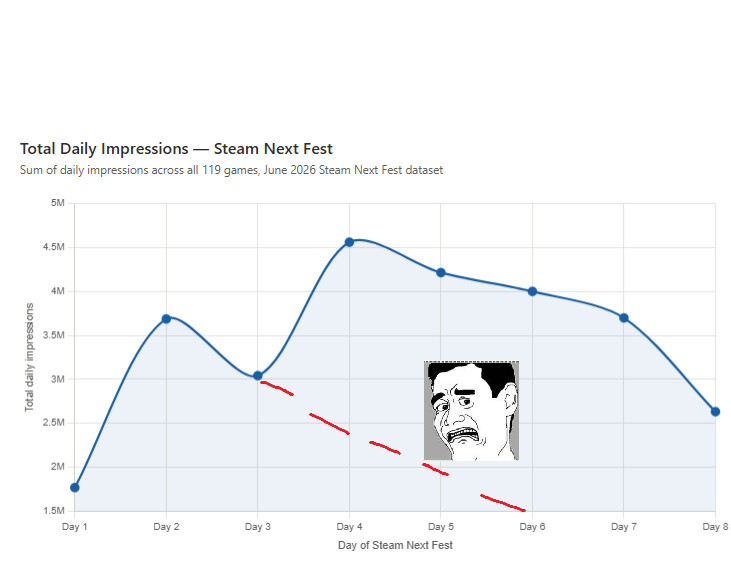
In the survey, I asked developers how many impressions their game got every day of Steam Next Fest. I then totaled up the number of impressions across all games in the survey. Here is that graph.
Total Daily Impressions — Steam Next Fest
No evidence Steam shoppers were “scared off”. In fact, the #1 day for impressions was Day 4 of Steam Next Fest.
If gamers were “scared off” the impression graph would look like this red line I drew in MS Paint where total impressions would fall off a cliff.
Also Day 1 and 2 were the lowest full-visibility days of the whole fest. Steam fans know to come back later and they aren’t “Scared off”
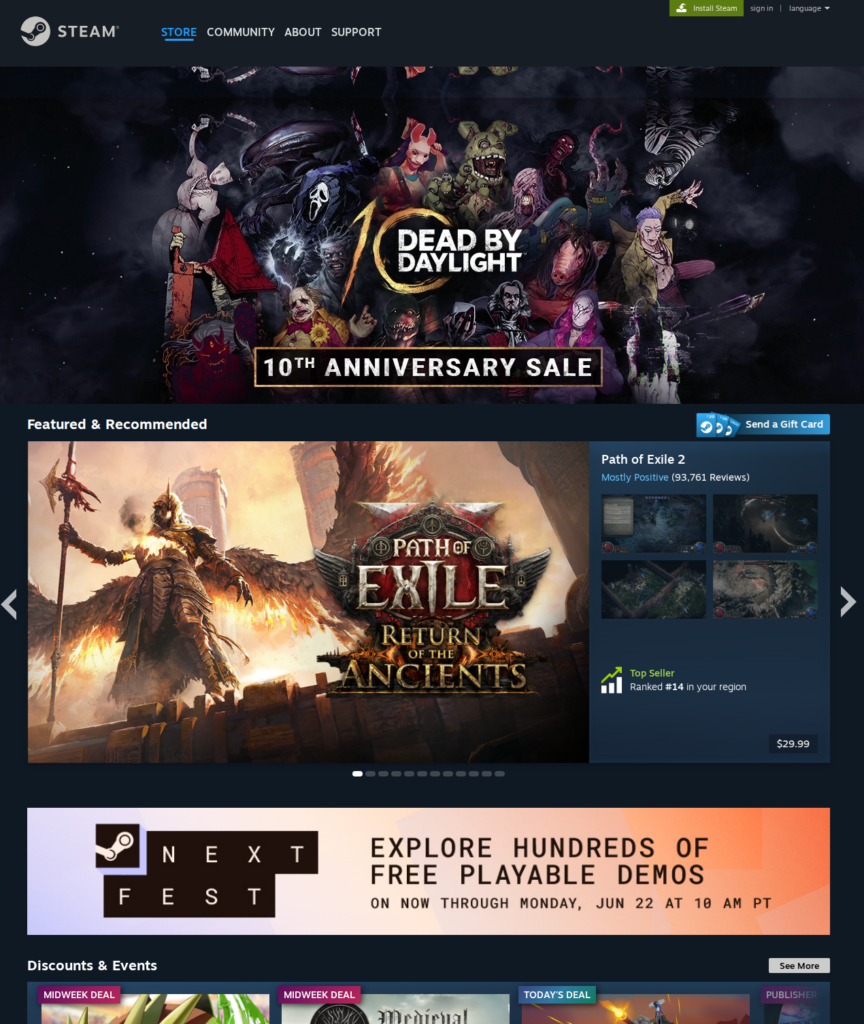
Other interesting bits about the TOTAL impressions graph: The dip on day 3 is because Steam Next Fest is relegated to a pop-under. Here is a screenshot I took on Day 3 (June 16th). All developers in SNF panic on Day 3 because SNF is not advertised as hard and some big game takes the top banner spot (Dead By Daylight in this case). This happens every single SNF and developers complain every single time. Don’t freak out.
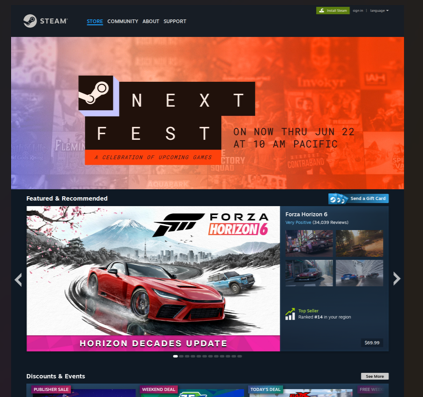
But don’t worry, because every year sometime between Day 4 (Wednesday, June 17th) and Day 5 (Thursday, June 18th), Valve moves Steam Next Fest back up to the top banner. Here is the screenshot I took on Day 5. That return to the top is the reason for the impressions bounce across games in the survey.
Every week on Steam, Thursday, Friday, and Saturday are the busiest days because people are getting off work and spending their weekend playing games.
My theory is that yes Day 1-2 is a slop fest, but comparatively fewer people are on Steam those days. The people browsing on Day 1 & 2 are just the die hard Steam super fans, youtubers who make videos complaining about slop, journalists who write articles complaining about slop, and Steam market researchers who sell courses. These diehards (or Sickos if you like) are the people who sort the slop. They are the taste makers. Then, the normies sign in on Thursday night, see the big banner, and check out a perfectly curated Steam Next Fest.
I know slop on Day 1 and 2 looks gross, but it really doesn’t affect normal gamers looking for games. People don’t get “scared off” of Steam Next Fest.
Steam Next Fest runs just like a rock concert: The first hour or two usually features an opening act (often of questionable quality.) Most concert goers know they should show up later to skip the opening act and only see the headliner. But die hard music fans might catch an up and coming band.