Benchmarks: This post is part of my series on marketing benchmarks that will help you understand how your game is doing and what is normal.
The data in this report was updated on September 14th, 2026. To read the archived report from 2022 click here.
To learn more, check out the full benchmark series by clicking the button.
How many wishlists should you get after you announce your Steam page?
Is it bad if your announce is “weak” and you don’t get a lot of wishlists? In this 2026 edition of the benchmark report I will dive into the latest data to see what is considered a “good” number of wishlists to earn in the 2-weeks after you make your Steam “coming soon” page live.
TL;DR what is “good” for the first 2 weeks of your steam page?
Answer: Here is how I would react based on various 2-week outcomes
- 0-20 = 😵
- 21-200 = 😬
- 201-1,000 = 🙂
- 1,000+ = 😁
Or to look at it from a revenue first mapped to a 2 week wishlist 25th percentile – 75th percentile
🥉 Bronze: 23-68 wishlists
🥈 Silver: 79-441 wishlists
🥇 Gold: 134-1,575 wishlists
💎 Diamond: 426-4,275 wishlists
But there is a lot of context. Please read the rest of this blog:
Here are a few clarifications and common misconceptions that come from very confident-sounding-but-incorrect people on Reddit:
- There is nothing in the Steam algorithm about a 2-week-announce window. My article here just uses 14 days as an arbitrary heuristic to measure all games against. Don’t read too much into whether there is a 2-week or a 1 week or a 24 hour visibility number. I just picked two weeks somewhat randomly.
- Valve does not penalize your game if it does not earn {x} wishlists within {y} days of announcing your game and releasing your Steam page. There is no “shadow ban” there is no “black mark” that hangs over your game for the rest of its life if it underperformed. Watch this official Valve video that says “Steam never makes a permanent decision about your game.”
- Do not buy a new Steam Direct Product Submission Fee if you had a poor announce or you took a break and didn’t do anything with your game for a while. Your game does not have a black mark. Throwing out your old game and starting getting a new App ID does nothing. Just start marketing that original game again.
- The Steam algorithm does not specifically promote new Steam pages like it does new demos or new game launches. There is no widget on Steam that says “Newly announced games.” Steam does not give any newly announced game special visibility to “try it out” or to “test” it.
- HOWEVER, you will see a spike when you launch your Steam page. But that is due to the “human algorithm” that says “new = interesting.” Humans (specifically journalists and content creators) love announcements. You can go to a content creator and say “this is new” and they are more likely to feature your trailer than if you say “I posted this trailer 8 and a half months ago, can you talk about it?” You can also go to a festival organizer and say “will you let me in if I announce my game during your festival?” So, just because Steam doesn’t give you visibility because you put up a new Steam page, doesn’t mean you should ignore your game’s announcement.
So in conclusion, yes, you should try to do some sort of promotion around your game announcement. Yes, you should have a trailer, and please hire an artist to make a professional capsule. Do not skip this.
Data sources and methodology
The data in this benchmark report comes directly from real developers with games on Steam who shared their data with me via this survey. None of the data here is estimated via follower or review counts. It is all real baby.
This survey featured data from 278 total games. 209 were released so I have sales data. 69 were unreleased at the time of publishing this post so I don’t have sales numbers from them. So if you see a graph that is about raw wishlists it will have 278 data points. If revenue is involved, the data set is 209.
Note: I am still looking for more data. I really want to look at how Steam evolves so I would love to see data from the 2017-2023 time period. But also accepting data from any year: please consider sharing your data using this survey.
Terminology used in this benchmark:
- Announce – When the Steam “coming soon” page was released. I then count 2 week after the starting date to calculate “announce wishlists.” The game is not for sale during this time.
- Release – When the game launched and could be purchased. All revenue numbers reported here are gross revenue (pre Steam cut). EA games are included in the data set and I consider the “release date” the first time people can buy the game.
The benchmark medallions and colors I use here are based on gross revenue earned at release. (n=number games in survey)
🥉 <$10,000 (n=86)
🥈 $10,001-$250,000 (n=74)
🥇 $250,001-$1 Million (n=27)
💎 >$1 Million (n=22)
What is a good number of wishlists when you announce your game
From the data, what is the range of announce-wishlists look like by earning tier
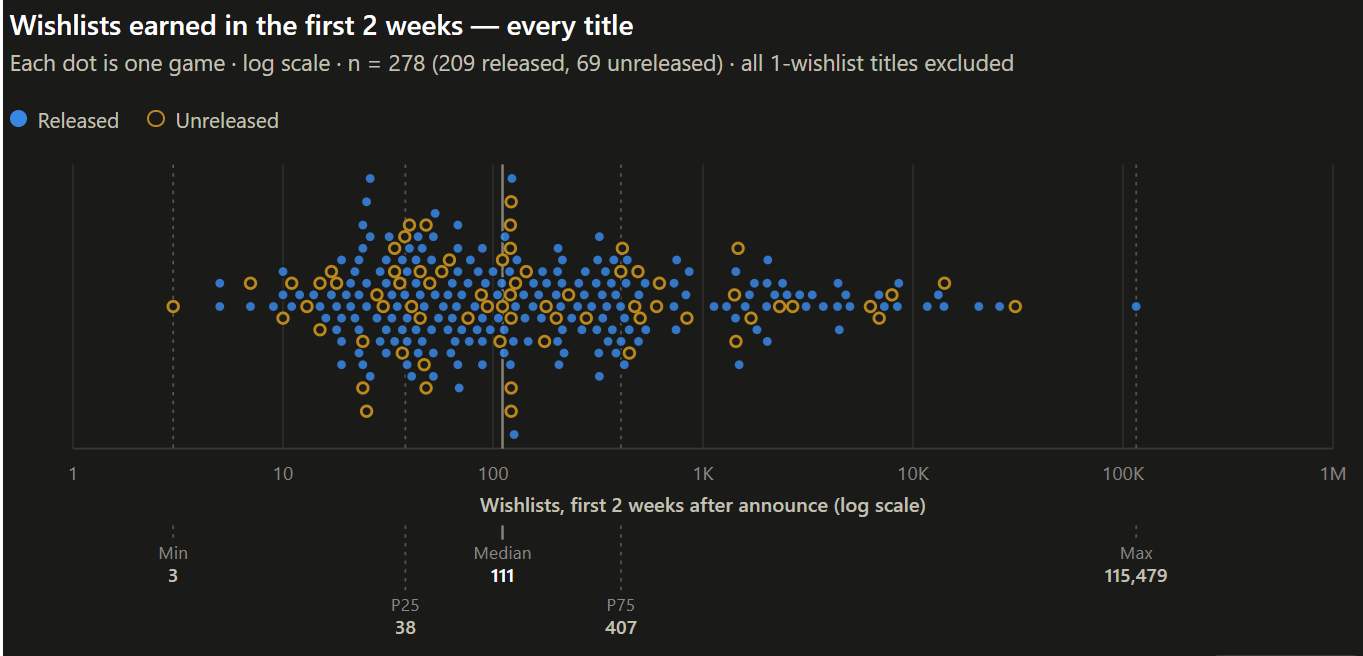
Stats on range of 2 week wishlist numbers:
- 25th Percentile = 38 wishlists
- Median = 111 wishlists
- 75th Percentile = 407 wishlists
Watch out with these numbers. Remember, the median Steam game earns something like $3,000 and will not be picked up by the algorithm. Really only the top 5% of games make enough money for the Steam algorithm to pay attention. It isn’t good enough to be better than the median game if you want to be picked up and promoted by Steam.
Correlation from announce to sales performance
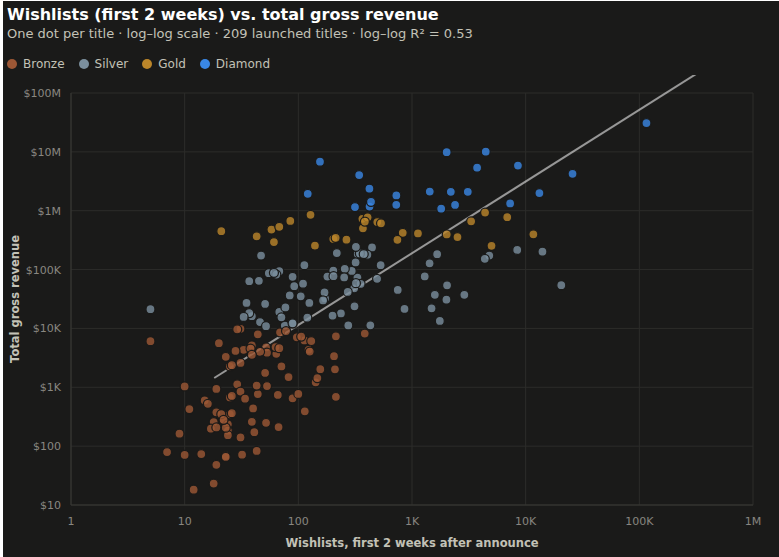
So does your game’s wishlist performance correlate to your final sales potential?
The statistical measure for correlation is on a 0 to 1 scale. 1 = perfectly correlated, 0 = random noise. Here are a couple ways of measuring it:
| Statistical measure | r | R² | Note |
| Linear Pearson | 0.85 | 0.73 | Linear Pearson can be influenced by huge outliers (mega seller games) |
| Log-log | 0.728 | 0.53 | Log-log is another tool to correct for outliers that can sway the data. |
As you can see in both metrics, announce wishlists are strongly correlated with eventual sales. That R² of 0.53 means wishlists at announce account for half the variance of the eventual gross revenue.
NOTE: I also calculated the correlation between launch wishlists and gross sales revenue and that had a correlation (log-log) of r = 0.887, R² = 0.786. I am doing a whole separate benchmark report on wishlists at launch, but for now know that total wishlists earned before launch is strongly correlated to eventual performance.
So yes, your announce performance does hint towards your game’s eventual sales, but not as strong of an indicator as launch day wishlists.
Pay attention to how well your game does at announce. A good announce is a real good datapoint to indicate that things are going well. But remember these numbers are correlated (not causal). I will explain practically (not statistically) this means below.
Ranges
So as we saw in the previous section, there is a definite relationship between the number of announce wishlists and revenue.
I want to put this in context so you can see what this looks like in practice. I understand, you just announced your game and are just watching the wishlist chart tick up slowly and want to know how much money you COULD earn. I present this to you but please be careful looking at this. More announce wishlists shift your odds in favor of one of these possibilities. But, the wishlists you earn at announce do not guarantee your game will achieve one of those revenue tiers. And when you see 0% bronze games in the 1000+ wishlist bucket, it just means I didn’t see any in my sample size of n=35.
Revenue tier mix, by first-2-week wishlist bucket
100% stacked · 209 launched titles grouped into 4 wishlist buckets
| Wishlist bucket | N | Bronze | Silver | Gold | Diamond |
|---|
Is everything getting worse?
I see a lot of indies fretting that trying every trick in the book to get wishlists (aka wishlist maxxing) is falling for "Goodhart's law". The theory goes that by focusing too much on gathering wishlists, indies are shooting themselves in the foot because those wishlists won't convert.
Is this true? Are we even actually wishlist maxxing?
Turns out ... no. Nobody is maxxing any harder now vs 5 years ago. Here is the median number of wishlists earned by launch year.
Median 2-week wishlists by launch year
2021–2026 · box = 25th–75th percentile, whisker = min–max · log scale · 187 launched titles
| Launch year | N | Min | P25 | Median | P75 | Max |
|---|
The median announce wishlist gain is basically random. Including surveyed games from 2014-2026 the correlation between announce wishlist gain and year is Pearson r=-0.13, p=0.058 which doesn't quite clear the bar for being statistically significant. The Steam meta is not changing as much as you think.
"But what about wishlists inflation!?!" Let's investigate. Because of the smaller data set in the early years I grouped the games into 2 buckets: 2024 and before (n=88) versus 2025+ (n=121).
The correlation between wishlists and revenue hasn't really changed. Here are the stats:
| Game release date and year in log-log correlation | ||
| 2024 and before (n=88) | r = 0.771 | R² = 0.595 |
| 2025 to today (n=121) | r = 0.694 | R² = 0.482 |
R² is the coefficient of determination and if it is R² = 1 that means # of announce wishlists definitely determine revenue and an R²= 0 would mean they are totally unrelated. Basically both buckets stayed the same 50%. The wishlists earned at announce have not changed to mattering more or less over the past 5 years. Steam doesn't change year-to-year as much as you think it does.
Is my game doomed?
~~~~~SWITCHING FROM STATISTICS MODE TO EDITORIAL MODE ~~~~~
Hello, Chris Zukowski here, I want to make it explicit that everything listed above had to be very carefully written because it's statistics and I don't want to overstate what the data shows. But now I am switching to editorial Chris. The following is based on my experience of looking at data like this and anecdotes and one off launches for the last 10 years.
I think a couple confounding variables explain why early wishlists are correlated to gross sales even though Steam explicitly says that the algorithm does not penalize games with a slow start.
Variable #1: Developer inexperience
Many first time devs don't realize you have to set up a coordinated campaign to announce your game. In fact I am often begging first time devs to please hire a professional capsule artist and to please have a trailer ready for your game announce. That lack of experience also manifests itself in the game. It is hard to make a game and if this is your first one, it will suck. You just have to make more games and you will get better at making them and you will get better at marketing them.
So all this coalesce around a central theme: these weak announce wishlists is often a symptom of not knowing how to present their game in a more professional way, also not knowing how to build excitement and pitch their game to the right people, and making a "good" game. This is hard to do, and you will likely fail at all of them at the start.
Variable #2: Developer experience
On the flip side, for the developers that earn 5000+ wishlists at announce did so because they know "a guy on the inside" from their long history of working in games. Geoff Keighley gives editorial guest spots in his game award showcases but typically to known devs who have shipped lots of games that are cool and interesting. So a developer's experience making cool interesting games also leads them to getting prime spots at promoting their announce. It is a flywheel.
Variable #3: Weak concept
Sometimes a game just isn't that great of an idea and people aren't excited about it. This industry is hard. No matter how hard you try to market it or explain it, it just isn't that exciting of a game idea. Even if you reach out to content creators, make a trailer, pick great screenshots, if the idea is boring, it won't get people excited. Content creators won't talk about it, IGN won't feature you. Then when the game releases months and months later, the same headwinds strike again. People still aren't interested in the game. So if you tried really hard, and did all the things to promote the announce, and it still hit low-tier wishlists, it probably is a sign the game has something at its core wrong with it. But how do you know if it is the game or the execution? See the next section...
Use this data to see how worried you should be
Consider your announce wishlists as a signal of your pace not as a prediction of your revenue. The announce benchmark can tell you if you need to be worried or not.
If you are a first time dev, and you are making one of those historically hard-to-market genres, and you didn't know you needed a trailer at announce, and you are not a professional artist, and you got 100 wishlists, you now have a data point that tells you: "This will be hard. There are signs that this isn't going to be a natural viral hit and you should not expect a huge payday at launch. (not that it won't happen, but don't be surprised if it isn't a hit.)"
If you had a below-median wishlist announce (111 wishlists), here is my advice: work hard in small tests to see if things change but be ready to move on. Try making shorts content and if that doesn't work, focus on your demo. Launch your demo, does that improve wishlists? No? GET THAT GAME OUT SOON. Don't keep grinding. Don't quit your day job yet. Don't think that spending 7 more years improving the game is going to turn it around. Don't rewrite your engine, or redo your art 3 times, don't spend 6-extra months making a level editor. Cut extra features. Get it out, learn, make your next one. If it is a surprise hit, you can add back the deep side quests and bonus boss rush mode and mod support.
A recent example of how to think about it
Last month I profiled the success of How Many Dudes. They earned 422 wishlists during their announcement 2 weeks. That is in the 75th percentile, but that is quite low for a team that has released multiple hit games.
The team is experienced so they knew that this was not a good sign. So they took a "saving throw" mentality: try high risk, high reward swings. The team was considering cutting the project short if they couldn't see any more signs that the game had a chance.
In an act of desperation they tried YouTube shorts and saw some modest success (see the red blips on their wishlist chart below).
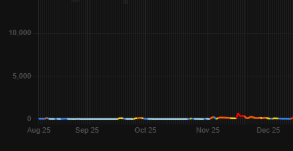
But viral YouTube shorts is not enough. They knew they had to hurry and get the Demo out. So they did in January and they finally saw the traction they needed:
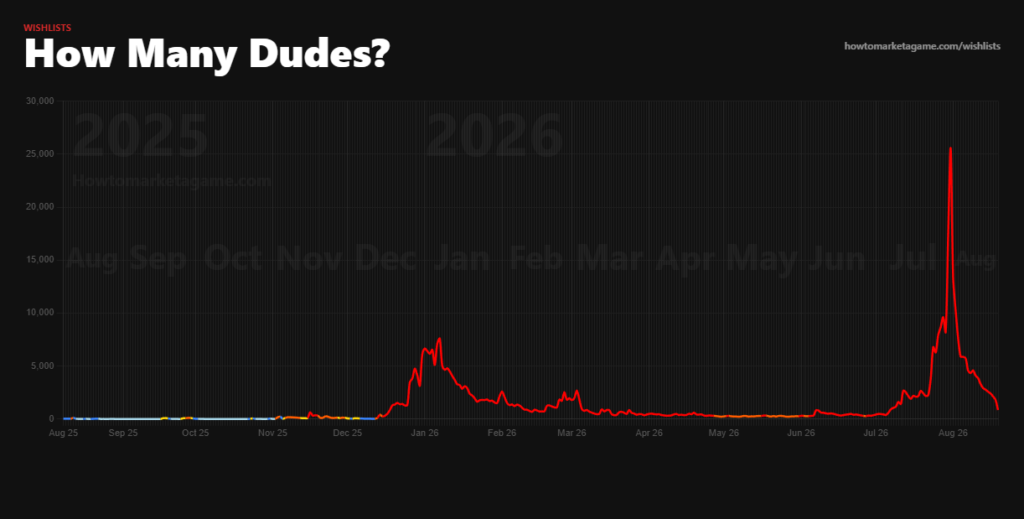
That second signal from content creators playing the demo and the Steam algorithm showing them the game more and more, gave them the reassurance to continue development for another 6-8 months.
This is what experienced game development looks like.
Use these benchmarks to tell you how scared you should be, and then react accordingly to get back on the right path. If your changes are not improving the baseline metrics, implement a risk mitigation strategy. Aka abandon ship.
For a first time dev, I think you should still ship your game. There are so many benefits to shipping even a failed game. But please, don't quit your job, mortgage your house, and hire a huge team to fix it.