This is the final installment in my blog series about the new Golden Age of games.
Valve just revealed its Best Sellers list for July 2026 and all this week I am looking at some of the games that made this list that had short development times. These are the “great conjunction games.” Here is a list of the other posts:
Today we are looking at Butterscotch Shenanigans How Many Dudes?
The game is an “autobattler roguelike, like a weird blend of Balatro, Slay the Spire, and Totally Accurate Battle Simulator. You run a dude ranch where you collect an army of dudes, create synergies with relics, and use all that dudepower to break the game.”
Why is this the golden age game? As they say in their blog: “In 10 months we made the most successful game of our 14 year careers.” It sold 242,000 units on Steam since launching on July 30th.
This is why I call this a golden age for small-scale indies. I know there is a lot of turmoil in the AAA space and if you were affected, my heart goes out to you. But for small indies who are focused on making these small, highly replayable games, they are experiencing the best years in the life of their studio. Let’s dig in.
Details
- Team size: 7 developers
- Dev time: 1 year to the day
- Game prototype launch (GMTK 2025 jam): July 30th, 2025
- Game announce: August 8th, 2025
- Demo launch: December 16th, 2025
- Game launch: July 30th, 2026
- Price (Discount): $14.99 (35% = $9.74)
- Genre: Roguelike Dudebuilder
Benchmarks: overall assessment: 💎tier ranking on several metrics
- Wishlists at Page Announce (14 days): 422 wishlists 🥉
- Wishlists at Launch: 308K wishlists 💎
- Demo median play time: 2 hours 2 minutes 💎
- Steam Next Fest: February 23rd (Entered with 175K WL): Earned 15.8K wishlists 💎
Campaign
Don’t read my blog yet. Instead, you should all read the new official Postmortem for the game by the Butterscotch Shenanigans team. It’s good because it also covers the game design decisions which I am not qualified to discuss. Also, listen to their past podcasts for even more insights.
So since I can’t describe the campaign better than they did, I will do some crazy assumptions and inferences. I think the most interesting thing about the How Many Dudes campaign is, how do you know when you have a hit? When should you give up?
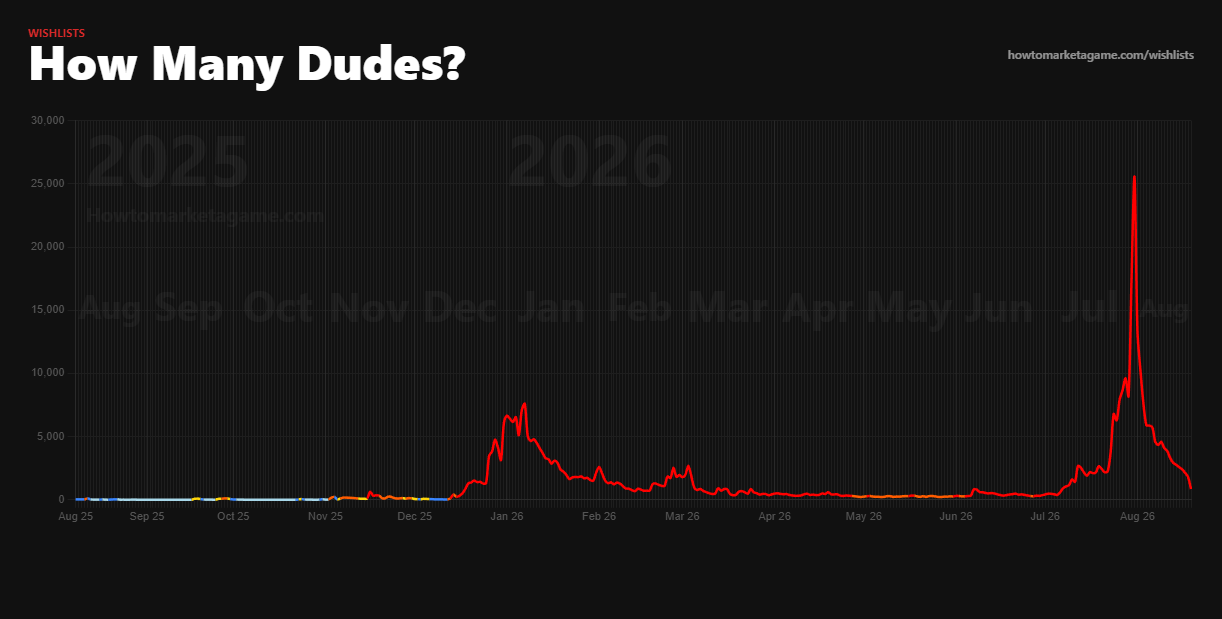
If you look at their wishlist chart, the blue color indicates a low daily wishlist rate of 10-50 wishlists / day.
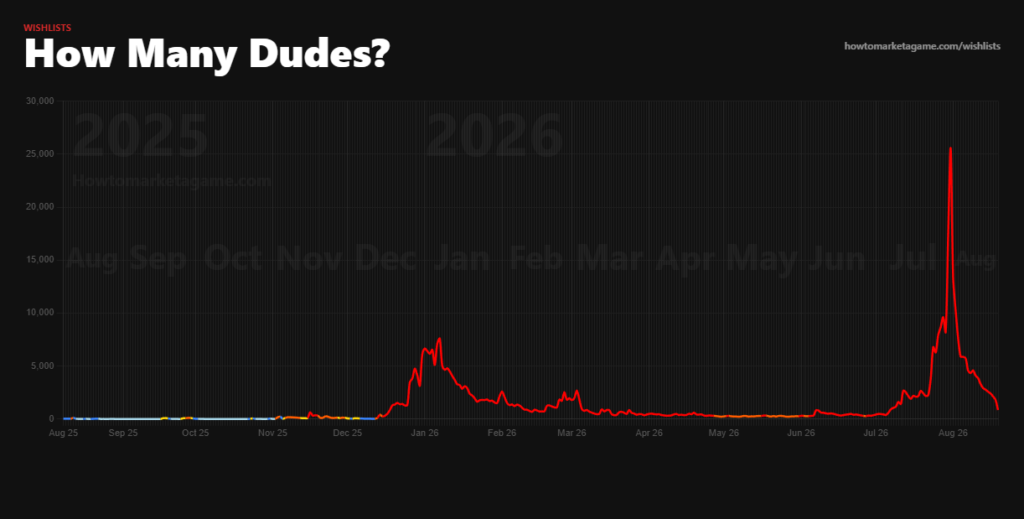
In the first 2 weeks, the team earned fewer than 500 wishlists. That’s bronze tier on the benchmarks.
If we only looked at wishlists in those first 2 weeks, you could have said “nope, cancel this game.”
But I have seen time and time again, that the launch of your Steam coming-soon page does not determine your game’s success. I always see Reddit comments about how Valve will “shadow ban” or “put a black mark” on your game if early wishlists aren’t coming in. That is not true. How Many Dudes is proof of that. Bills Must Be Paid is too (read that blog).
I only post those benchmarks because people are curious how their game is doing after 2 weeks because refreshing the Steamworks Financial page is more fun than game dev. So I have to report something. But the metric is pretty meaningless. It is a good sign if you get 💎diamond tier in your first 2 weeks, but it isn’t necessarily a bad thing if your announce is soft.
A lot of people ask me if it makes sense to launch a Steam page for a faked-out (sometimes AI-drawn) game concept and see if it gets traction and only develop it if it does. The case study of How Many Dudes says we don’t know. It’s not a good test until you get a demo…. more on that in a second.
Shorts to the rescue
The team was stuck in the wishlist doldrums. Nobody was excited about their game. So in a bit of a Hail Mary, they tested YouTube Shorts.
The results were promising. Two successful YouTube Shorts earned them 769 wishlists! Good!
Short video content has been useful for many game devs lately. It is currently the most potent form of Social Media. BUT I do want to point out the limitations. Social media is fun, it is neat when you “go viral” but it has a very short shelf life. This is their wishlist chart during this YouTube Shorts period but before the demo went live.
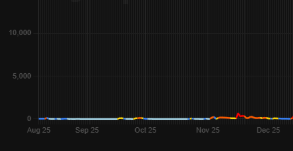
Blue indicates 20-50 wishlists / day. Notice how there were just a few pixels that turned yellow and red. The Steam algorithm did not wake up from these viral posts. It is good, but it doesn’t last long. It is a sugar high.
A lot of new developers assume that social media IS marketing. They assume once you “go viral” you are “made.” But that isn’t necessarily true. Real sustained success with marketing doesn’t come until you get a demo and you activate the Steam Algorithm to promote you.
If I zoom out, this is what the wishlist chart looks like when the demo and the algorithm hit.
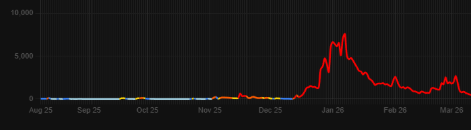
After the demo hit, they never had a single day that was in the “cool”. The wishlists that come from the Steam algorithm like New & Trending Free, The Discovery Queue will dwarf anything you can do with social media. They don’t crash, they find a new resting rate.
That doesn’t mean social media is bad. Social media is good at enabling future success. I am sure their viral videos got the attention of content creators and enough people to support the launch of their demo, but social rarely works alone. You must use it in conjunction with the major marketing beats such as the Playtest, demo launch, Steam Next Fest, and the Launch.
So treat social media as the tiny kindling, and the major marketing beats as the logs.
But don’t worry if you can’t get social media to work. For most games, the visibility comes from Demos and store-bound visibility widgets. So don’t give up yet.
The demo launch + Trending Free
A demo is the most important marketing tool but NOT because players get to try out your game; most wishlisters and buyers don’t actually play your demo (I wrote about the player/wishlister paradox here). A demo is useful because it unlocks a bundle of Steam widgets and access to visibility through festivals and content creators.
One of the most consequential moves for How Many Dudes was launching their demo and getting onto New & Trending Free during the Steam Winter Sale.
Why?
Nobody launches games between Christmas and New Years Day. That means if you can appear on front page widgets like New & Trending, Popular Upcoming, New & Trending Free, you will stay on them for weeks. Those widgets are basically queues and when new games release, they bump off the old ones. If nothing is releasing, nothing is bumping you off.
I documented how New & Trending Free doesn’t move during Christmas in this blog post
By scraping the New & Trending free chart daily, I found that How Many Dudes spent at least 24 days pinned to the front page of Steam.
The end of the year front page gambit earned them 36,946 wishlists.
THAT IS WHAT I MEAN when I say that the Steam widgets are the #1 biggest driver of visibility, not social media. Social media helps, but the Steam algorithm gets it done.
The demo is what turned them from a bronze tier game to a Diamond tier one. If your game has IT, you might learn it from social media, but you will definitely learn it after you launch the Demo.
Launch and success
There are many additional marketing beats the team did here such as Steam Next Fest. I will let the postmortem cover the explanation of how that worked. Butterscotch Shenanigans was also one of the first games to fully utilize the launch of the Personal Calendar (hint: it is a good thing).
So instead of rehashing their launch campaign, I want to zoom out and look at their history. Every Butterscotch Shenanigans game is basically in a different genre.
- Mobile (too many to list)
- RPG (Crashlands 1)
- Platformer (LevelHead)
- RPG Again (Crashlands 2)
- Rogue-lite / Deckbuilder (How Many Dudes?)
I like to look how genres perform against each other from the same Studio. Here are the concurrent user counts for all their games.
Concurrent User Count (CCU) (series is launch-date aligned)
Despite being the shortest development time, How Many Dudes had the highest CCU and the longest sustained player base.
Also, note the blue line hugging the X-axis; sad little platformer Levelhead 🙁
Established studio
It’s a mistake to assume that rapid release games are just for studios looking for their first hit or “first time game devs” or “hobbyists.” A gaming studio is not like a video-game progression where you must continuously upgrade and take on bigger and bigger projects. You can step back and make a small one. For fun.
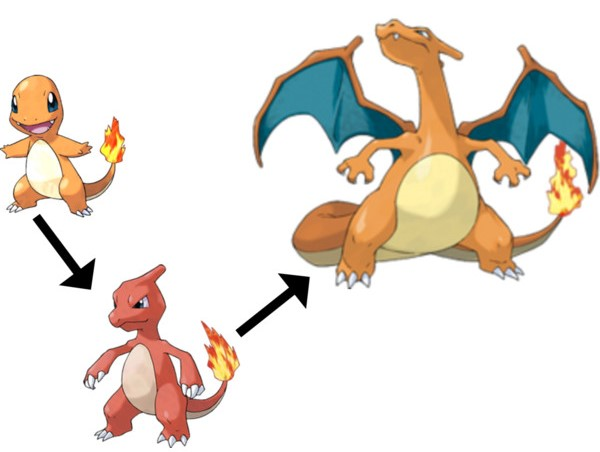
Game studios don’t evolve up to the next form after every game release. It is ok to step back and make smaller games.
The Butterscotch Shenanigans studio has been around for a decade plus. They have had multiple hit games that can support a 7-person studio. Even with that much experience, they benefited from taking a break and making a smaller game after the 5-year development of Crashlands 2.
From just a software standpoint, working on a new project with a known scope of like a year is just infinitely more fun and freeing than working on a software project for two years, four years… everything becomes a slog as it grows. – Adam Coster on Coffee With Butterscotch Podcast
You don’t have to make bigger games.
It isn’t just Butterscotch Shenanigans:
- After Another Crab’s Treasure the team at Aggro Crab made a quick little game called Peak.
- Ghost Ship Games made Deep Rock Galactic and then partnered with a smaller studio to make Deep Rock Galactic: Survivor a Bullet-Heaven version of the IP.
Making smaller games is for everyone. If your team is stressed, or has a skunkworks team looking for something to do, a small rapid-release game could end up being your studio’s best selling title. The scale of game development does NOT guarantee the scale of your success.