It feels like Steam is always changing. Every month there is some “hot new genre” rendering the game you are making completely out of date. But is that actually true?
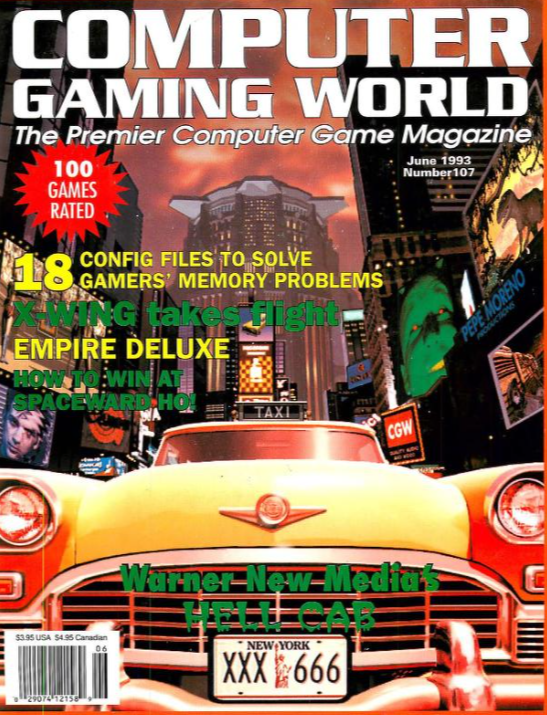
For a sanity check, I bought a 1993 edition of Computer Gaming World magazine just to remind myself of where PC gaming was 30+ years ago.
I bought CGW in particular because at the back of every issue they publish a reader poll ranking the readership’s 100 favorite games. This is great quantitative data that I can graph, compare, and track.
So to check my “vibes” I graphed the reader poll from June 1993. Shockingly, this graph looks pretty “Crafty-buildy-strategy-simulationy” doesn’t it?
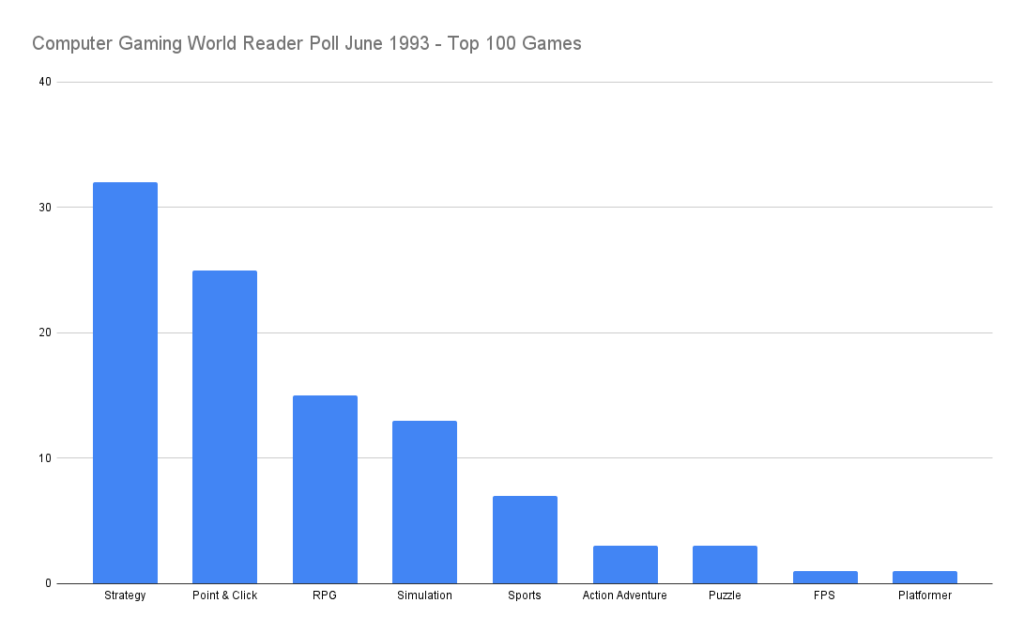
Top genres: Strategy, Point & Click Adventure, RPG, Simulation.
Least favorite: Puzzle and platformer.
*NOTE: for a bit more context on this, see the next section
My general thesis is Steam and TYPES of games that resonate with the Steam playerbase are rooted in the legacy of PC gaming. There is a certain culture that endures 30+ years later.
TL;DR of today’s blog is this: Steam actually hasn’t changed that much from it’s PC roots and rather than worrying about how much is changing, look to what is consistent but evolving on top of it.
For developers who were console-first during their formative game-playing-years, you may have been imprinted with a certain “style” of game. Unfortunately, console gaming is quite a different culture than its PC counterpart. I think many indie game “failures” are because developers who have a “console-culture” mindset are trying to make a game for an audience that is “PC-culture.”
Ironically, the feeling that “Steam is changing”, is more likely that the individual developer is. These console-first developers are learning in real time and by looking at their sales data, that the genres that might work on consoles, don’t work on Steam. I often find the most successful developers with first time hits on Steam grew up playing PC games. They understand PC as their native tongue.
It is possible for developers who grew up console-first-and-only to learn the culture of PC and make successful games, but the first step is just recognizing the differences. This is also where I see a lot of friction from developers. “But I don’t like those types of games” is the common refrain. Well, when in Rome, do as the Romans do. And Steam is video games’ Rome.
Once you realize that Steam’s ancestor is PC culture, you will see that not much is changing
In today’s blog post I am going to point out a bunch of things I saw in the June 1993 edition of CGW that rhyme with today’s Steam marketplace. If you want to browse the whole magazine, there is a scan up on the Internet Archive.
If you want to watch me browse the magazine with commentary, I also uploaded a video:
Note about the graph:
I built the above graph based on this “top 100 chart” that CGW editors put together. In every issue there was a card that contained 100 games picked by the editors. Readers were encouraged to evaluate the list and rate every game they played on an A-F letter grade scale then mail it in to the magazine. Every issue the editors would tabulate the results and present it on the last few pages of the magazine.
Here is the actual chart from the June 1993 issue of CGW.
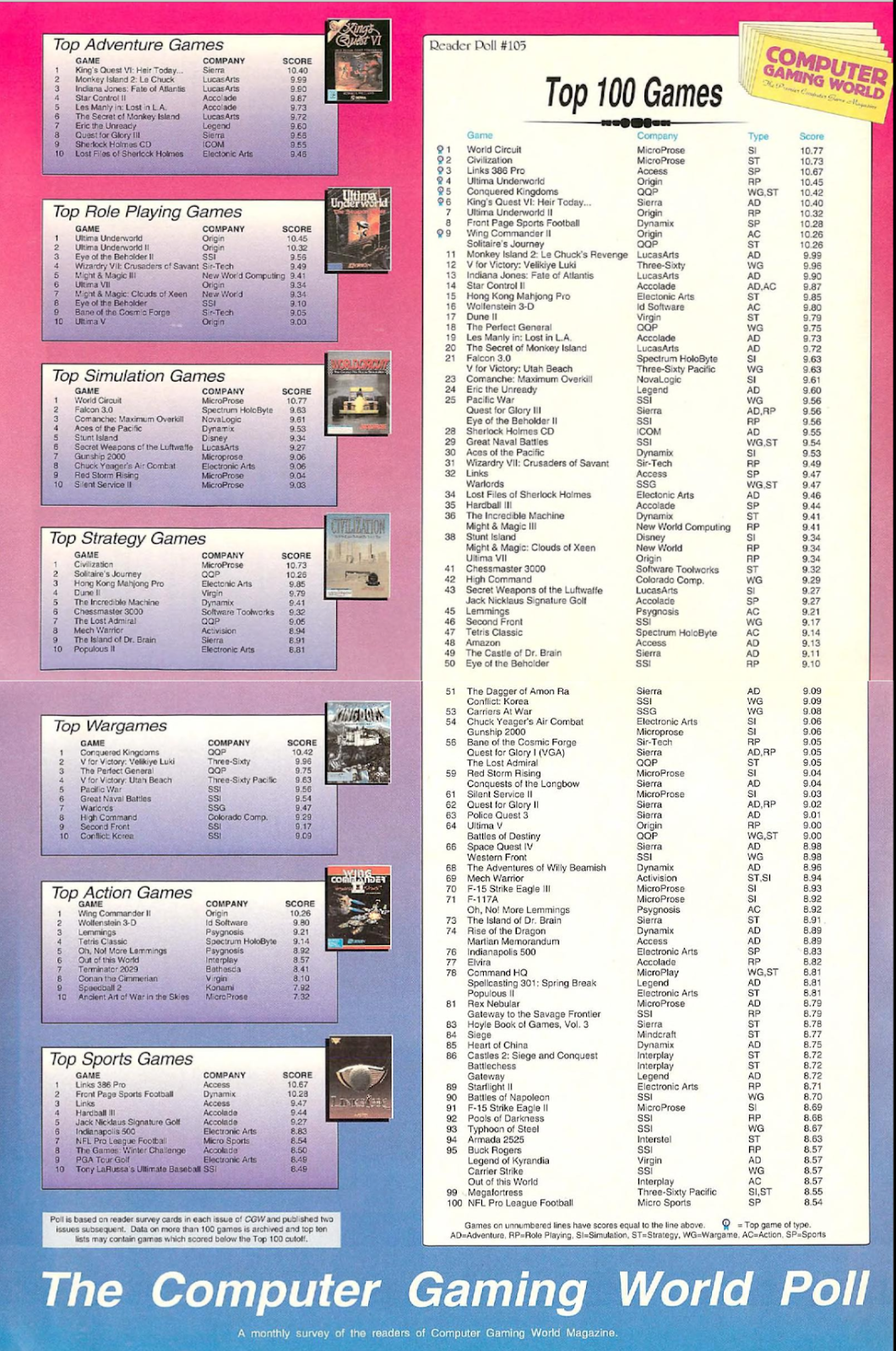
We can all poke holes in this pre-internet method of collecting data and the sampling, but it is a neat bit of quantitative data that is stronger than anecdotal evidence such as “well I used to play some platformers on my dad’s work computer.”
The genres in my graph were provided by CGW editors. For my bar graph above, I did make some genre adjustments:
- I moved Tetris and Lemmings out into “Puzzle” (they were listed as “Action”).
- I moved Wolfenstein 3D to FPS. (It was also “Action.”) – I just broke it out because it was interesting to call out.
- I merged “Wargame” into “Strategy”. I guess Wargaming was a big distinction back in the day which is now almost meaningless.
- I moved Out of this World to Platformer (It was also “Action.”) The magazine never used the word “platformer” but I did that to show how few true “platformers” there were at the time on PC.
Also, I know there was Commander Keen, Prince of Persia. But puzzle games or platformers never showed up on the top 100 list. Platformers were big on consoles but the editorial board or the readers didn’t dedicate much real estate to discussing them in the magazine.
Things from 1990s PC culture that hasn’t changed
Here is a random sort of things that I pulled from the magazine that show, although it seems like Steam and the games on it are changing a lot, there isn’t that much new.
#1 The PC aesthetic is still grim dark, gritty, fantasy
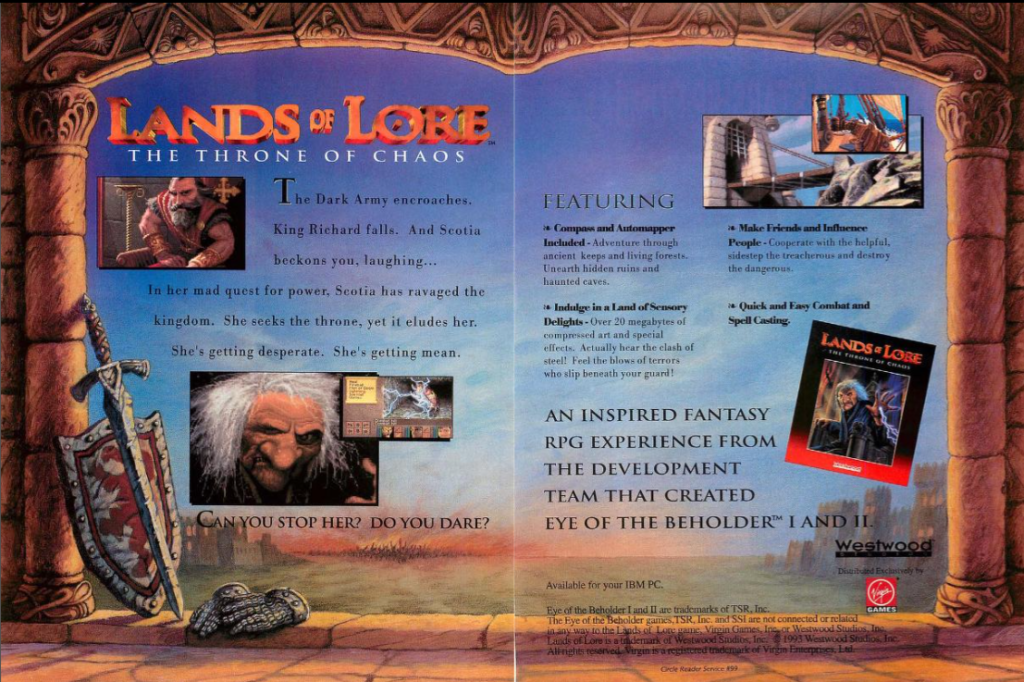
Look at this ad for Lands of Lore. Look at those brutish guys. Look at that tracery work on the framing architecture. This could be the capsule art for a Hooded Horse game today.
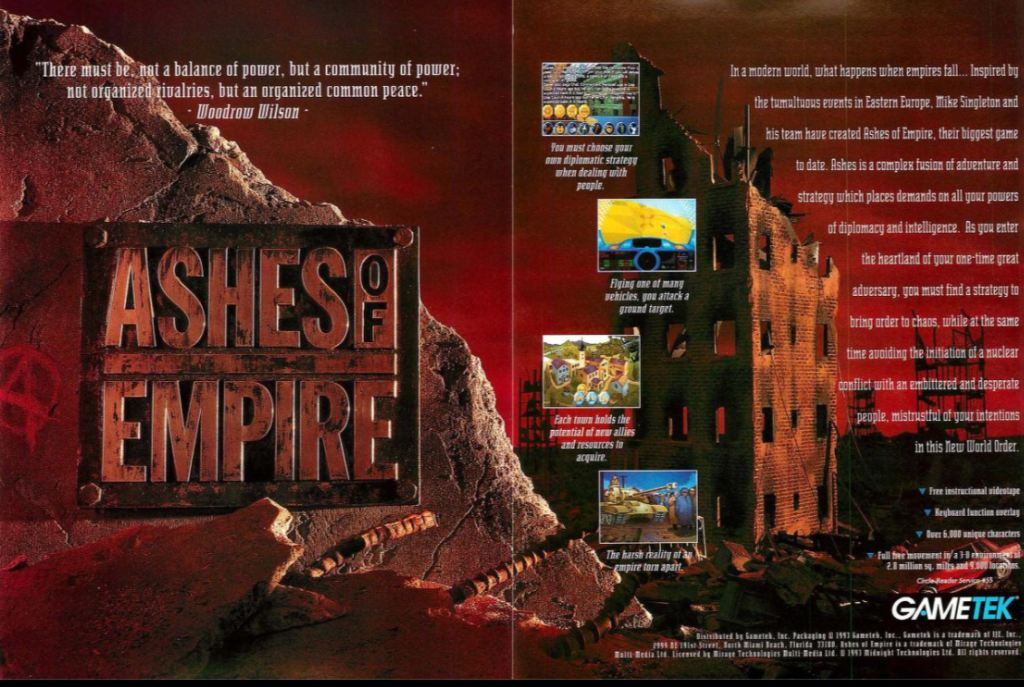
Look at how gritty this Ashes of Empire ad is! Broken rebar?! Roughed out concrete. Perfect.
#2 Sex existed before you were born
Here is a full page advertisement from the magazine for the first Hentai game brought to the western market.

PC gaming has an older-player-base, open, non-gate-kept market, and that means that NSFW content flourished here. People complaining about NSFW content on Steam (which is consistently only 10% of all games) don’t realize that it has always been a thing on PC. There is nothing new. Steam didn’t suddenly get invaded by porn, it has always been there, it will always be there.
#3 EA has always had crappy software and support, Bethesda has always been janky
In an article about customer support CGW asked readers to rate what companies had the best support and which had the worst.
EA had the highest net negativity rating at -14.
Bethesda next at -6.
Things never change.
Also look at how much people love MicroProse and Sierra.
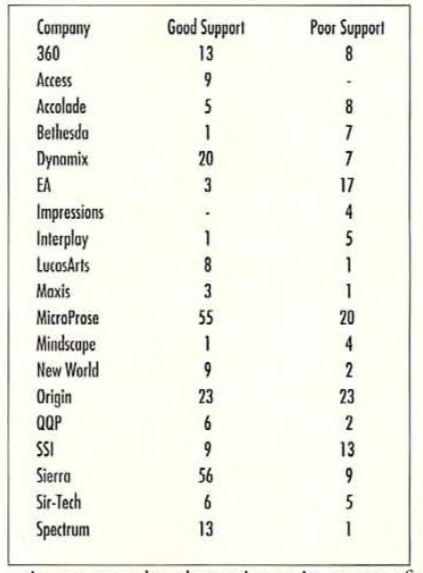
Side historical note: In retro gaming circles a bit of revisionism has emerged around the idea that Lucas Arts made the good, cool, better written, point & click adventure games while everyone knew that Sierra made trash ones where you would have walking-dead states if you didn’t grab the coin from the fountain before you fed the ants by the old mill. But looking at this data, people loved Sierra. Their support had a +47 while Lucas arts only had a +7.
Granted this data is tracking Support calls. Maybe people like Sierra support because they helped you finally defeat the Ice Queen using the fish you found in the bottom of the barrel and obtain the 7 Keys of Vamtoozler from Hansel and Gretel where as the superrior Lucas Arts puzzles didn’t require support because they were better written.
#4 PC players value complex UIs
Both Steam and PC players love complexity. They want deep complex games that are hard to figure out but reward deep understanding.
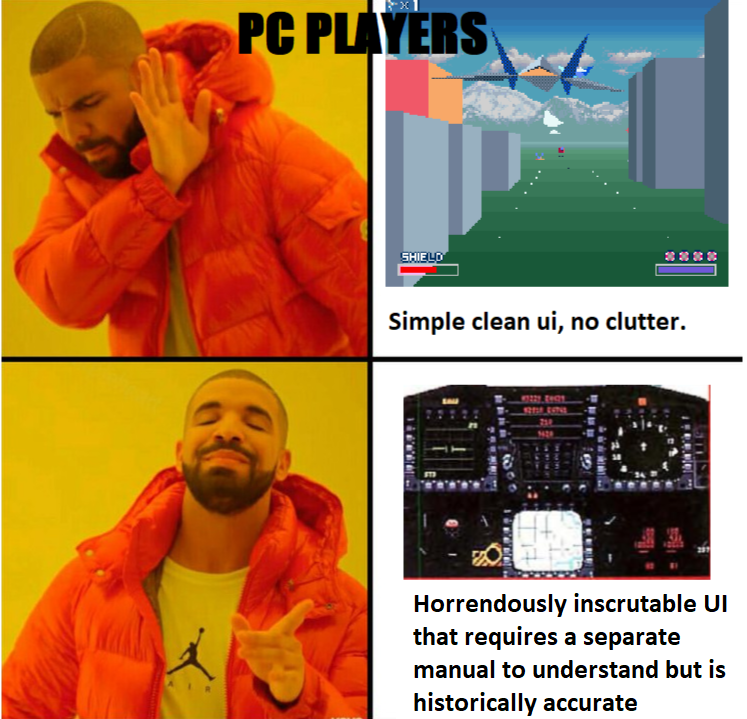
The dev impulse to say “We removed all UI so that you are immersed in the experience” is not always the right direction for all PC players.
A complicated UI tells PC players “this game has depth. This game will become your life.”
Look at this ad for a flight simulator where the UI is the main selling proposition. SIDE NOTE: I told you… show UI in your Steam screenshots.

Look at this UI for Hearts of Iron IV which was released in 2016. Look at this nasty-ass UI. THIS IS PC-Style.
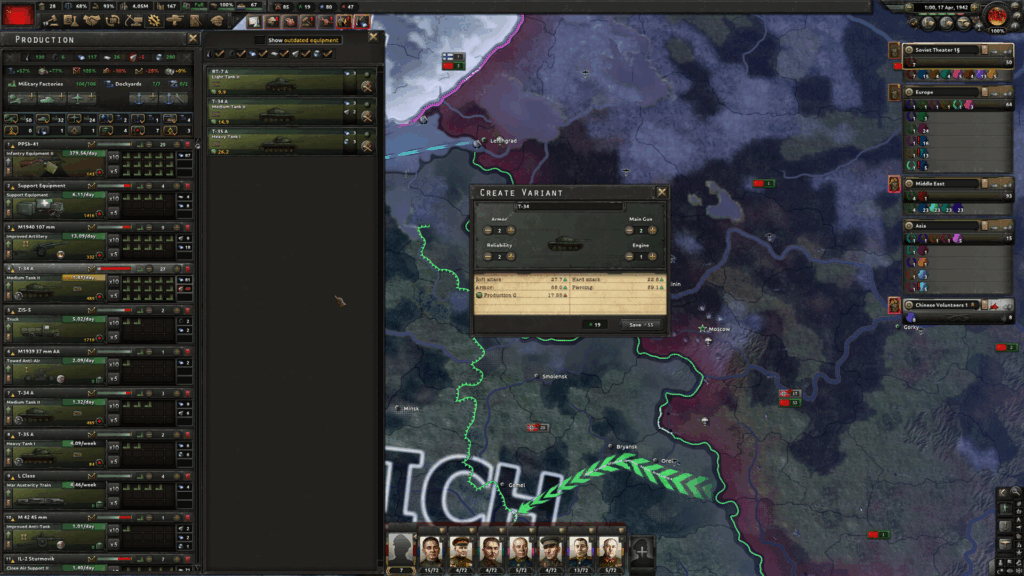
Clean UI says it is for children on consoles or losers on mobile. Complex UI says this is a “real game.” (That is pc players saying that, that sentiment does not reflect my views or opinions so don’t yell at me)
#5 Indie game developers exist and are hustling
XBOX Live digital distribution did not invent Indie Games. The people in “Indie Game The Movie” were not the first indie developers. The fact that a PC can both play and make a game means that the concept of making and selling your own game is as old as the system itself.
Skimming through the magazine you will see a couple ads like this one.

Individuals used to place ads for their games in physical magazines. This guy provides his home phone number but asks that you call him on “Evenings Only” (timezone not specified). Also note that he lists “Department C” in the address. I looked the address up on google street view and it’s just a house. He just calls his office “Department C” to sound official.
Gotta love the gumption to try and sell a game with no screenshots, and limited descriptions of the games. You just had to trust you were getting the game after mailing this guy a check. Also he was selling his games for $25 each which was $56.82 adjusted for inflation. Games really have gotten cheaper.
Computer Gaming World also had review roundups of indie games. There was no “wishlist on Steam” call to action. Instead, the creators home addresses were just listed at the end of the review with a phone number. People used to just Dox themselves and everyone survived.
#6 Indie game developers don’t know how to market themselves
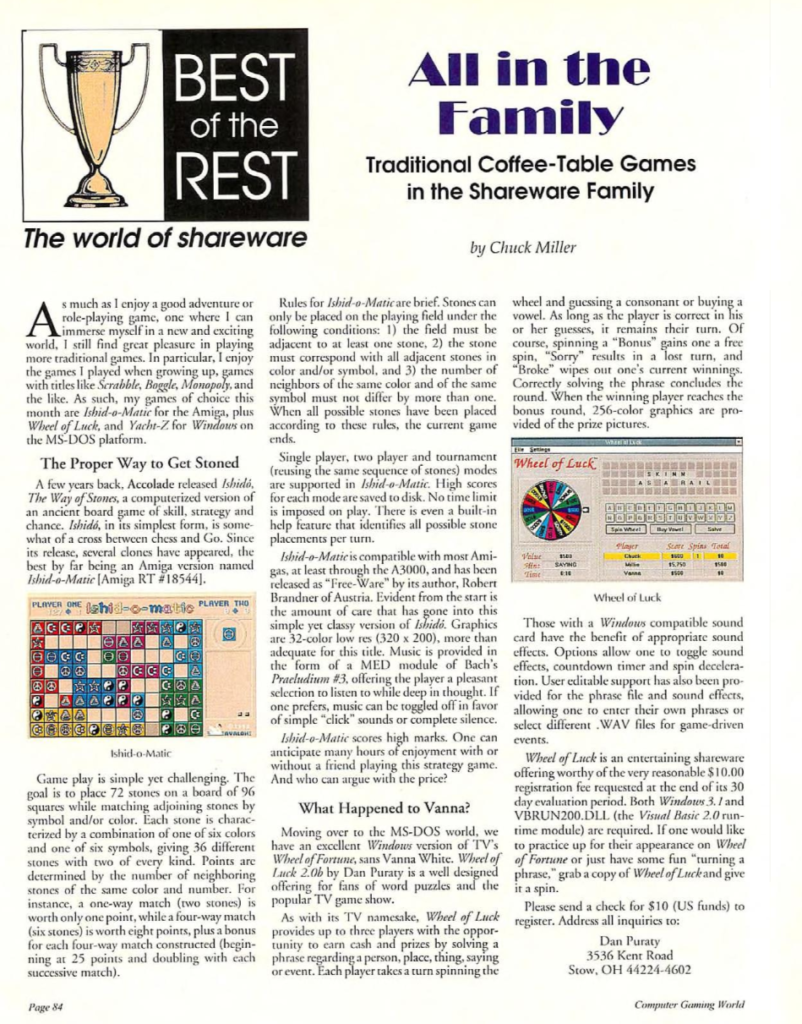
The most interesting part of the indie “review “Best of the Rest” section was that the editors added a special section begging developers to please make their games more presentable so they could actually write them up in the magazine.
Look at these tips
- “Submissions should be sent on a NEW floppy disk…at the least, use a new label and type the name of the program on it.”
- “Include a printed or typed cover letter that describes the submission.”
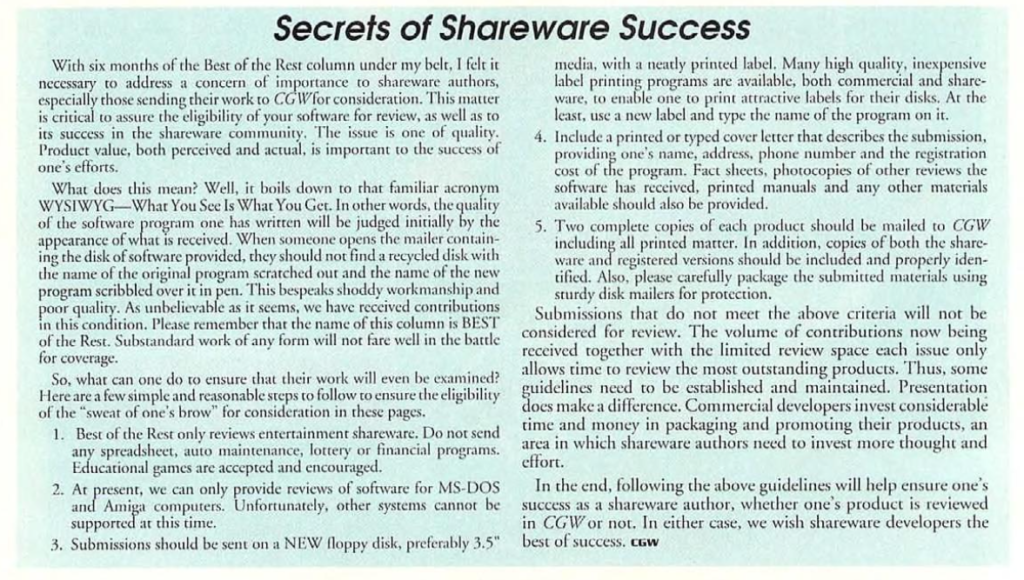
This checklist is almost exactly like the blog post Wanderbots wrote to ensure that indie devs actually give him the right information for coverage. He also tweeted this guide:
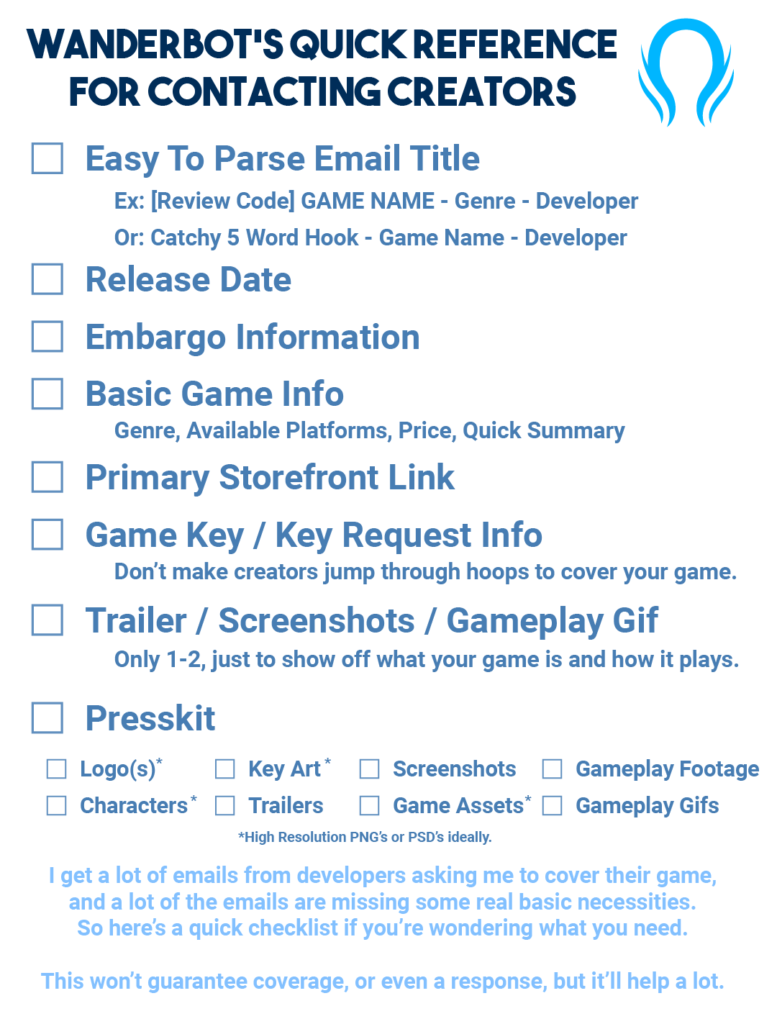
Please, put in the effort when you are reaching out to people who might cover your game.
#7 There were “too many games”
Here is a mail order catalog ad where you could order games direct from “Disk-count software.” I roughly estimated that this list has 1,130 games for sale. That is denser than the Steam Front page. Discoverability has always been hard.

#8 A controller is NOT the primary way PC gamers interact with games
In CGW you see a lot of ads for controller peripherals. Like this:
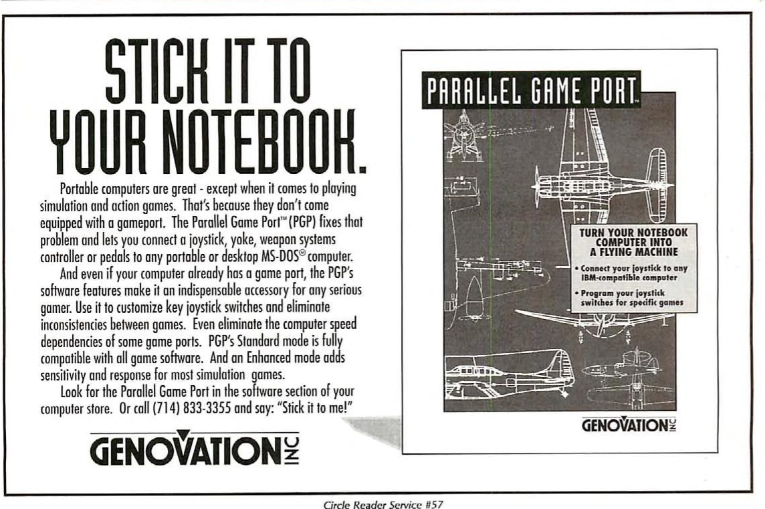
Or this
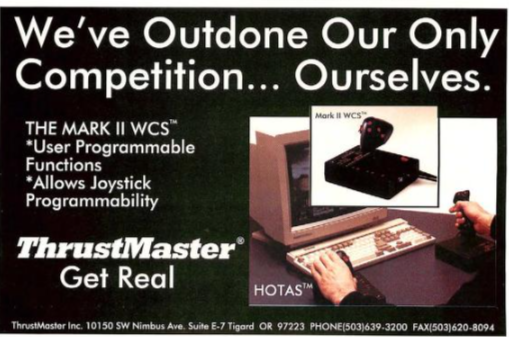
Or this awesome one where you can turn your desk chair into a cockpit:

There is no standardized gamepad or joystick on PC like there is on consoles. If you wanted to use a joystick, you had to buy separate peripherals and sometimes install special ports into your computer to connect them. It was expensive. It was time consuming. Developers could not assume that players had a controller.
On PC, the only standard was a keyboard and later a mouse. So those were the primary forms of game input.
Not much has changed:
Since 2018, daily average controller use has tripled from ~5% to up to 15% of all sessions
- Steamworks blog
I think this aversion to controllers explains why platformers just aren’t popular on Steam. The player base just likes games with a mouse and keyboard. AND I KNOW, some people played Celeste on keyboard. But that is insane.
#9 PC players are more hard core than you expect even after you account for them being more hard core
Here is a 100% serious letter from a CGW reader describing his gaming setup. He bought an old fighter jet cockpit and installed two gaming PCs in it complete with a canopy that encloses him in a protected bubble of gaming. He even installed a phone and intercom inside the system so his wife can call him to dinner.

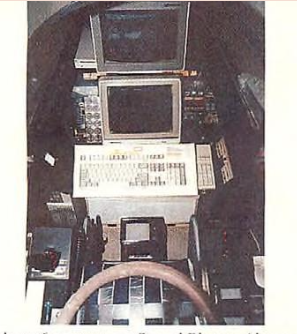
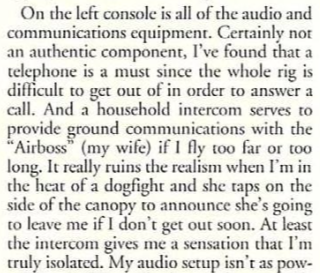
This is why I think it is a mistake to market your Steam game as “A short game that respects your time.” Jetfighter guy built a physical bubble into his house so he wouldn’t be bothered. He does not want to get out of his bubble. Respecting this guy’s time means giving him a game that has so much content he can continue to live in his bubble. Only his wife can break him out of it.
This guy is why I think indies should stop trying to target “casual” gamers (see this blog). You should target hard core gamers because they are willing to drop thousands of dollars on their hobby. Buying your game is nothing to them when they build their own jet computer.
Respect player’s time! Give them a game that wastes lots of it. They will thank you for it.
#10 The PC player is superior to console heathens (in their mind)
PC players only slightly-ironically call themselves the “PC Masterrace” In their mind they are older, smarter, more hard core than those console simpletons.
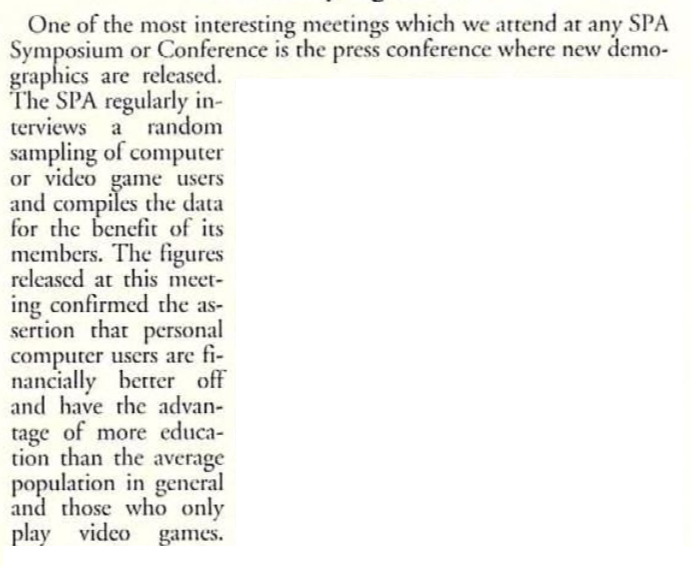
And they aren’t wrong exactly. Look at this article about some data that was presented at a conference. Check out this quote specifically. (Note at the time “video game users” means console gamers.)
The SPA regularly interviews a random sampling of computer or video game users and compiles the data for the benefit of its members. The figures released at this meeting confirm that personal computer users are financially better off and have the advantage of more education than the average population in general and those who only play video games.
#11 Horror is very popular, and everyone underestimates it
In this review for “Alone in the Dark” this reviewer says “horror seems to be the ‘in’ genre this year…So it’s still a rich field, and the publishers are finally getting around to sowing a few seeds.”
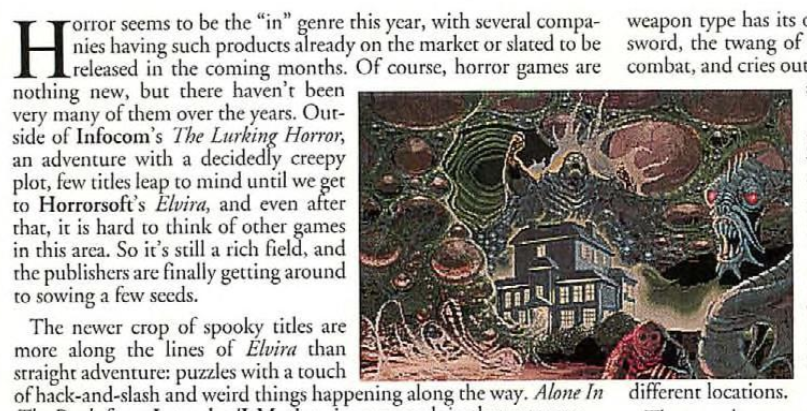
Everyone always underestimates the presence of horror games on PC and is surprised that it is such an important genre. Every year I collate all the games that have earned over 1000 reviews and there are consistently more horror games on that list than any other genre. But the press never writes about how popular horror is.
Devs don’t believe it either. They say “Is horror still going to be a thing? Chris said it is so that means it will be oversaturated next year.”
Just like in the film world, I think horror is looked down upon as crass and in bad taste. It rarely makes the “best games lists.” But fans are like “WE LOVE THIS.”
Horror was popular 30 years ago, it will be popular in 30 years in the future. It never changes. I still think every indie should make one horror game.
#12 You need professional art to market your game
In the middle of the magazine is this full page ad by Michael Winterbauer who did amazing box covers for games like Wing Commander.
Check this copy: “When you need the finest in computer game illustration, call Michael Winterbauer.”
This is a “capsule” artist advertising himself in 1993.
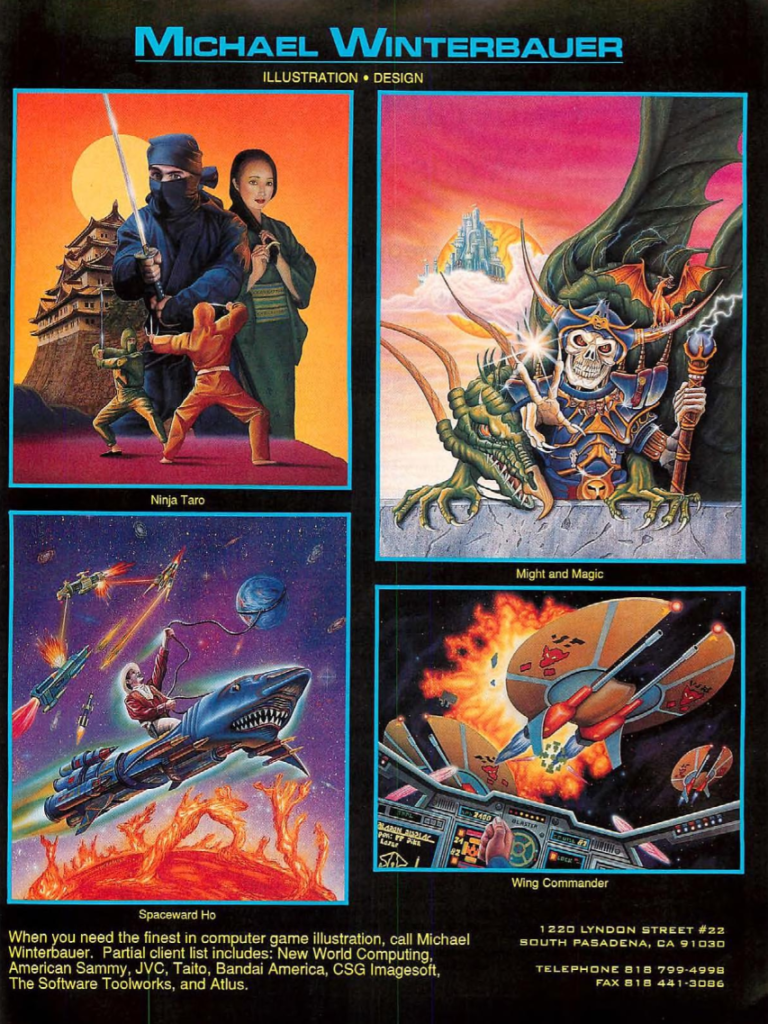
Michael is still working today (facebook link). Not sure if he still takes commissions, not sure his prices. Maybe you can hire him, it would be a cool callback to classic PC gaming to have him make your capsule.
Summary: What has changed?
The top genres in 1993 were Strategy, simulation, RPGs, and narrative games in the form of Point & Click adventures. The players were hard core. They research everything about a game.
This is why I am not worried that Steam will be filled with AI slop, or pay-to-win F2P junk like the more casual app stores. There has to be a final refuge for the “true gamers.” The PC playerbase is so hardcore they destroy anything that has a whiff of being a cash grab. They really do like gaming for gaming sake.
However gaming culture has changed in some ways from the 90s.
First, these are new / diverse genres:
Although crafty-buildy-strategy-simulationy games were big then and now, the big evolution that separates 1990s and 2020s PC is the depth of the genres.
Point & Click has shattered into Visual Novels and action-adventure dude-with-a-sword games. I think some fans of P&C adventure games were fans because those games were the AAA titles of their time. They were the best visuals, most interactive stories, highest production values. When other genres became more epic than Point and Click (like FPS), the fans moved over to FPS
City Builders used to be lumped into Strategy or Simulation. There are still city builders today, but there are also factorio style games, tower defense (with city builder mechanics), farming games like Stardew Valley, and cozy management games like Minami Lane and Tiny Glade.
Crafty games aka Open World Survival Craft games like Minecraft, Valheim, and ARK: Survival Evolved are a new addition to gaming but I would argue their lineage comes from the Open World games of Bethesda as well as resource rich action dungeon crawlers like Diablo.
Basically every parent genre is still the same, but niches have flourished. There has been a great Cambrian explosion and there are sub sub sub genres that didn’t exist in the 1990s.
So yes the “niche” genres might change or emerge or sink every 5 years or so, but if you pull back and look at what the grand-father genre it evolved out of, you will see that it is almost always Crafty-Buildy-Strategy-Simulation (and horror) games.