In many of my Q&As I get the same question: “We launched our game 2 months ago, sales were slow, what kind of marketing should we do now to start selling more copies?”
My answer is, if it didn’t sell well in its first month, it never will. The game is over. Time to start working on the next one.
It’s the harsh reality. In today’s blog post I am going to show you just how hard it is to come back.
But Among Us came back after weak sales…
I looked at every game that was released in 2024 and an absolutely miniscule number of games (28 which is 0.156% of all games released in 2024) “did an Among Us.”
My definition of games that had a “weak” launch are if they had fewer than 150 reviews in the first 30 days after launch.
My definition of a game “succeeded” is any game that earned at least 500 reviews.
In today’s blog I am going to look at those 28 games that “pulled an Among Us” to see what it takes to turn around a failed launch.
Methodology
🚨FIRST GOODHART’S LAW ALERT🚨
In this blog I use some benchmarks at 150 reviews, 500 reviews, 1000 reviews. There is nothing in the Steam algorithm about these numbers. You don’t get special visibility when you reach these numbers, you don’t get chocolate. I just picked these numbers as a random benchmark number. PLEASE DO NOT FOCUS ON THE SPECIFIC NUMBER. I just used it as a measure. Do not buy bots to get you to 500.
For this blog post, I used VGInsights to download data for all of the games released in 2024.
Every year I look at the games that earned at least 1000 reviews because that is a pretty good indicator that the Steam algorithm saw good enough traction that it was worth promoting to more people.
The problem is that I do my review of the previous year in the first week of January.
That means if a game released on December 31st it would only have 1 day of sales history and therefore likely miss my “games of 1000 reviews.”
For this blog, I went back to the games of 2024. Every one of those games now has at least 365 days on the store. I pulled the data snapshot I took of the 2024 games on January 1st 2025 and compared it to a snapshot I took on February 1st 2026 of those same 2024 games.
Then I sorted every 2024 game that has at least 500 reviews now (because sometimes games can be high earners with as few as 500) and I looked at how many had fewer than 150 reviews back in 2025 when I took sample #1.
Side note, VGInsights counts Early Access (EA) games based on their initial sale. So any game that went to EA in 2024 is counted here.
If the game transitioned to 1.0 in 2024 but did did their initial EA in say 2022, they would not appear in this data set.
So therefore there were only 28 games released in 2024 that earned fewer than 150 reviews in month #1 and then turned around and got at least 500 reviews.
Here is a mega graph of all the games:
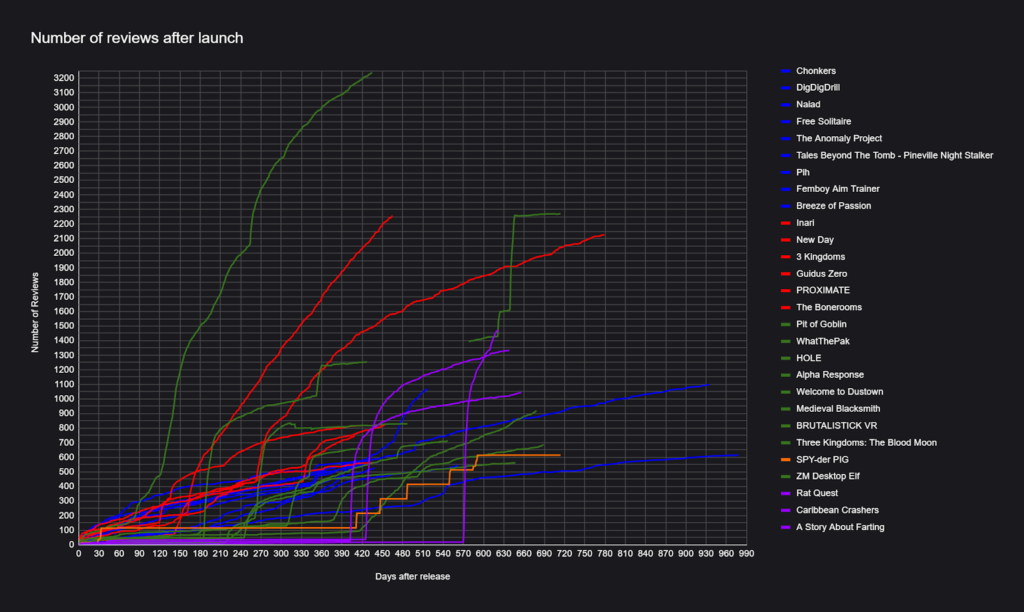
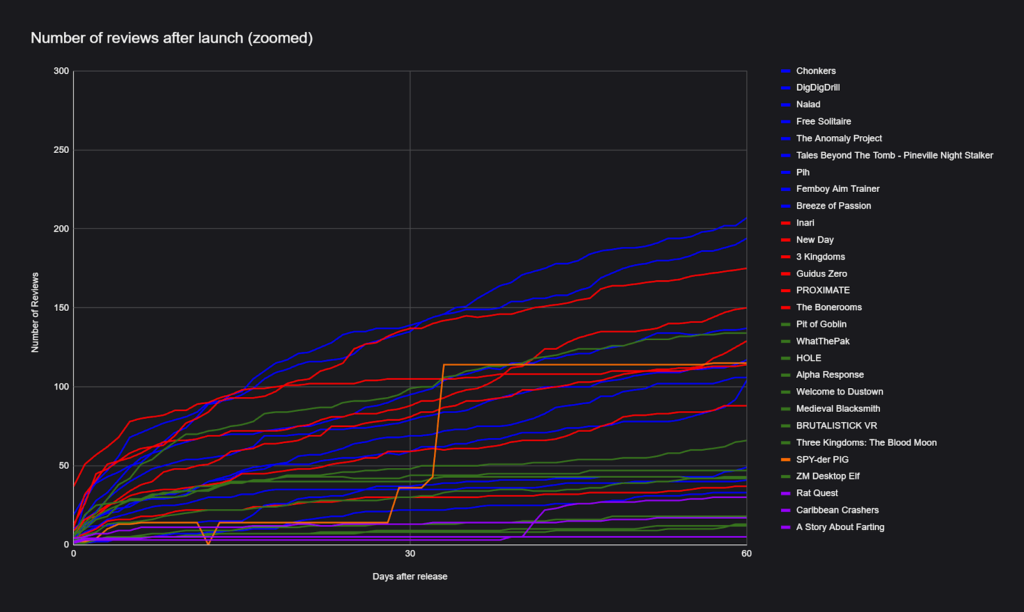
That is hard to read, so I zoomed in on the first 60 days. As you can see, none of these games had 150+ reviews at day 30 after launch.
Even at 2 months only 1 of these games exceeded 200 reviews.
What does a typical successful launch look like?
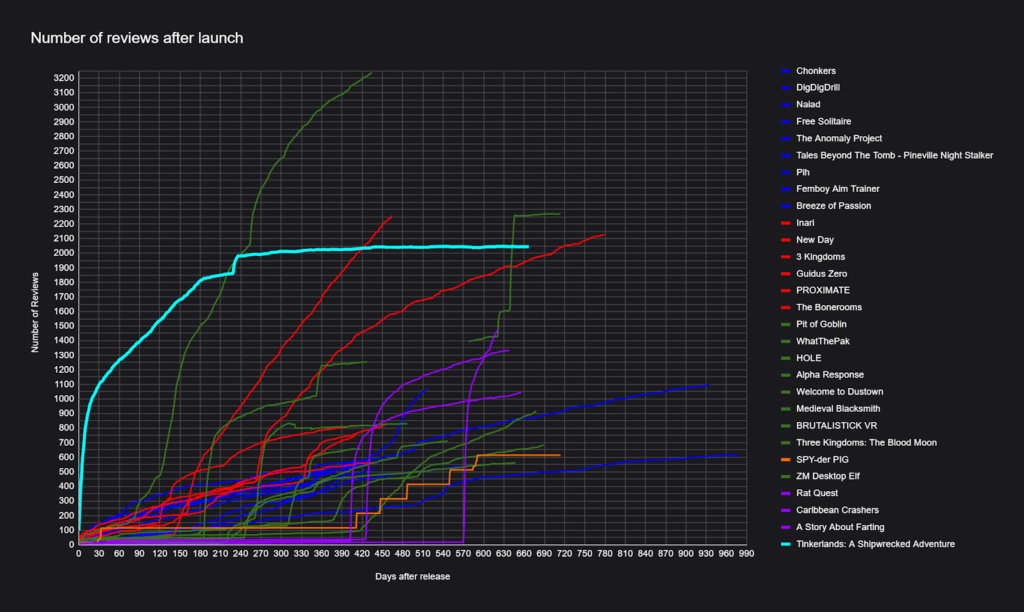
Just for comparison’s sake, let’s add a more typical game that hit 1000 reviews at the normal pace that hits do.
I randomly picked Tinkerlands: A Shipwrecked Adventure because it hit the 1000+ reviews benchmark I use. It was a hit but it wasn’t a mega viral hit. Tinkerlands is the bold cyan line there.
Notice how it got to 1000 reviews in 1 month. That is typical for MOST hit games. The Steam algorithm looks for early interest and then quickly escalates the game’s visibility in the algorithm.
See how Tinkerlands outpaces all the other games. However, even with all that visibility it stalls out around 2000 reviews. What’s interesting here is there are a couple of the slow build games that that eventually outperform it in the long run (we will examine those in a bit).
I dug deep into each of these games and there were 5 basic ways they pulled the turnaround
- Slow and Steady growth
- A viral moment
- Slow & steady growth + a viral moment
- A free weekend jump-start
- “Abnormal” behavior
Slow and Steady growth
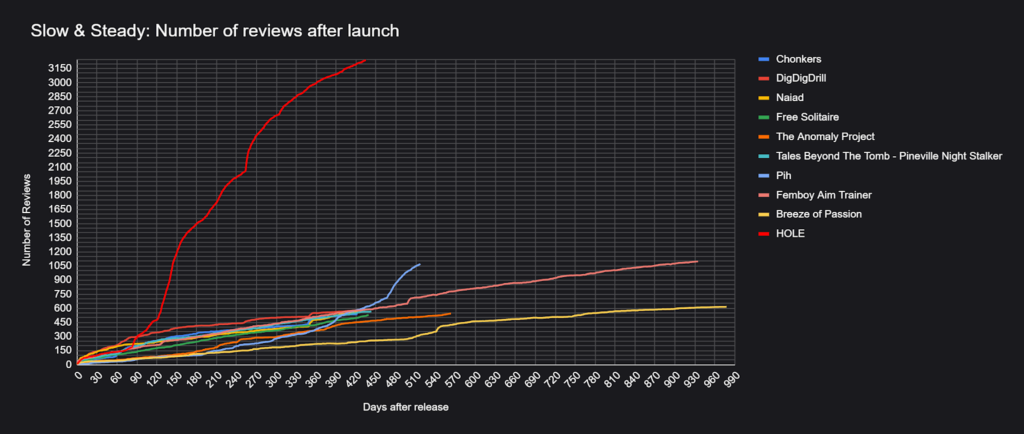
Here is a graph of what slow-and-steady games look like
Here is a list to those games with some details
| Game | Reviews as of February 2026 | Price | Coming soon page age at launch | Followers at launch | Genre |
| Chonkers | 536 | $4.99 | 67 days | 4405 | Idle |
| DigDigDrill | 573 | $3.99 | 228 days | 153 | Management / Mining |
| Naiad | 557 | $19.99 | 1127 days (3 yrs) | 5235 | Adventure |
| Free Solitaire | 527 | Free | 12 days | 5 | Card game |
| The Anomaly Project | 543 | $7.99 | 77 days | 8 | Horror friendslop |
| Tales Beyond The Tomb – Pineville Night Stalker | 566 | Free | 14 days | 58 | Horror |
| Pih | 1070 | $8.99 | 129 days | 13 | Shooter |
| Femboy Aim Trainer (NSFW) | 1098 | $0.99 | 76 days | 65 | Adult |
| HOLE (suprisingly not NSFW) | 3237 | $4.99 | 189 days | 99 | Shooter |
| Breeze of Passion (NSFW) | 615 | $14.99 | 13 days | 174 | Adult |
Analysis
The nearly linear growth of these games indicates that these games are probably growing by word of mouth. Friends telling friends and not big viral bursts like a single content creator covered them.
The interesting thing here is that most of these games didn’t follow the traditional marketing meta: They didn’t spend at least 6 months collecting wishlists (180 days), and/or they didn’t gather 5000+ wishlists by launch (about 500 followers).
I think this really shows how important marketing is. I haven’t played them but their steady growth indicates they are GOOD GAMES. I am not sure what caused the poor marketing performance but it seems like something went wrong here. Maybe these games didn’t do a demo, reach out to enough content creators.
I bet for many of these games if the dev team had gathered more wishlists by launch, they could have showed up in popular upcoming, then new and trending. We would have seen a growth trajectory like that of Timberlands
Pih & Hole are the big winners here.
Hole is a huge hit. I shouldn’t consider this Slow and Steady. It is like fast & steady. Something just wasn’t getting done marketing department for the first 2 months after launch. Then it was discovered. You could honestly consider Hole a “hidden gem” that was discovered late after launch.
For Pih, note the late breaking exponential growth about 460 days after launch. I probably should have classified this one as viral, but the first part of its release was definitely slow and steady.
How to replicate this
I don’t know if you can. Your game either grows by word of mouth or it doesn’t. You just have to have the right game for it.
Viral moment
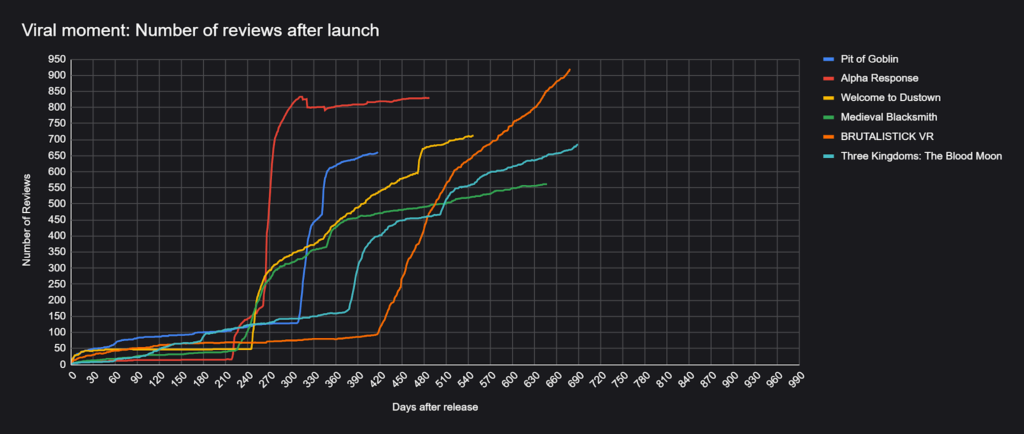
All of the games in this category are marked by their relatively flat, non-existent growth and then one singular event happens and boom they shoot up like crazy. This seems like the discovery that every developer of a failed game hopes for: “maybe today someone will discover my diamond in the rough.”
| Game | Reviews as of February 2026 | Price | Coming soon page age at launch | Followers at launch | Genre |
| Pit of Goblin | 661 | $5.99 | 52 days | 139 | Horror Friendslop |
| Alpha Response | 830 | $19.99 | 14 days | 10 | Co-op Shooter |
| Welcome to Dustown | 713 | Free | 49 days | 32 | Horror Friendslop |
| Medieval Blacksmith | 561 | $19.99 | 66 days | 102 | Management |
| BRUTALISTICK VR | 920 | $9.99 | 135 days | 21 | VR shooter |
| Three Kingdoms: The Blood Moon | 684 | $8.99 | 47 days | 21 | Roguelike Deckbuilder |
How do you get this viral hit? Luck?
It’s often keyed off by a single content creator finding the game and loving it.
Also note that almost all the games in this category had anemic pre-release marketing. Only 1 games (The Bonerooms) had coming-soon page up for the recommended 180+ days. None of the games had 7000 wishlists at launch.
This tells me they didn’t reach out to enough content creators. Didn’t have a demo live long enough to gather interest. These games had something amazing about them! If they had just done a better outreach pre-launch these viral spikes would have happened way before and the Steam algorithm would have done its magic at launch. Unfortunately these games missed out on that. They would have had more sales if they had worked with the Steam algorithm instead of against it.
Please! Market your games.
The big hit here is BRUTALISTICK VR and it was discovered by a VR content creator named Bucky. In the first video he said
“I got recommended this game in my comments and it looked pretty good.”
- Bucky
See! Word of mouth, that spilled over to a content creator. This is incredibly common.
Bucky went on to record 41 more videos about this game. You can see his playlist here
I don’t have insight into the Brutalstick team’s marketing process, but this is why you should try your best to do an exhaustive content creator outreach before launch. If only Bucky had found it out pre-launch, the team could have enjoyed the free promotional widgets Steam offers at launch.
Another factor here is luck: the rise of friendslop.
Note that 4 of these games are horror friendslop or a co-op shooter. These genres really had their moment the last few years. Sometimes you just luck out and your game’s genre becomes the hot “IT” genre.
How to replicate this
If you thought you were too cool for marketing and decided to shadowdrop your game in under 180 days, because that’s what the cool kids like Apex Legends did. Shame on you. Acknowledge your sin.
Then, please, market your game now as if you didn’t launch with a short runup. Try to do another round of content creator outreach. If you had any big coverage previously, use that to trade up and get more coverage. But, as Bucky said the game has to be “good” and people have to be willing to recommend it.
Slow and Steady growth & viral moment
The games in this category were doing pretty well, then something magic happened. Usually a content creator.
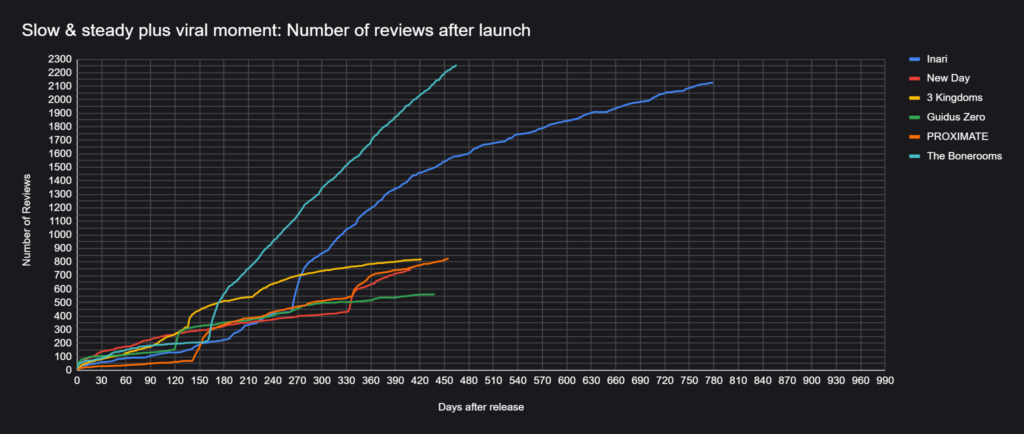
| Game | Reviews as of February 2026 | Price | Coming soon page age at launch | Followers at launch | Genre |
| Inari | 2126 | $14.99 | 55 | 127 | Adult |
| New Day | 747 | Free | 588 | 664 | Narrative |
| The Three Kingdoms: The Tales of Jian An | 819 | $17.99 | 14 | 73 | Strategy RPG |
| Guidus Zero | 562 | $14.99 | 83 | 480 | Roguelite |
| PROXIMATE | Horror | $5.99 | 102 | 22 | Horror |
| The Bonerooms | 2256 | Free | 316 days | 85 | Horror Friendslop |
The free to keep trick
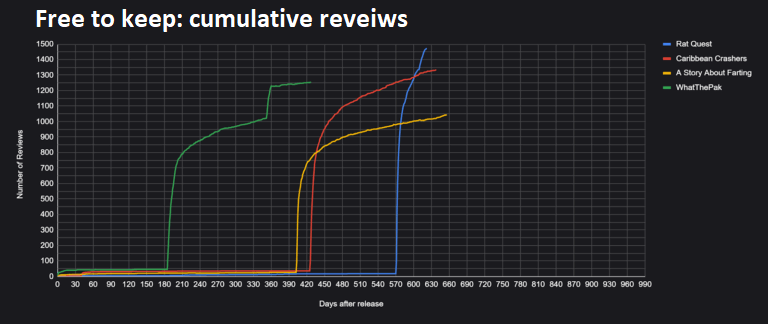
The games in this category are very similar to the games in the “Viral Moment” category: low review rate for months, then one big pop and thousands of reviews.
However, these games got their “Viral Moment” by setting their price for free for a weekend.
You might be aware of “Free Weekends” They are typically reserved for big-hit, well-known games (mostly multiplayer) that go free for a weekend to increase CCU.
To get one, you have to work with Valve to approve your game for it. Here is the definition from steamworks
A Free Weekend is a time-limited promotion that allows players to temporarily access and play an eligible game for free—typically over a long four-day weekend.
Unlike a Demo, which offers a separate demo build of your game via a separate demo app ID, Free Weekends grant players full access to your base game via its current app ID, albeit for a limited time. Free Weekends also differ from Free to Play games, which are always available at no cost.
Free Weekends might not make sense for your game. Read on for more details.
Steamworks
Usually valve will not allow your game to do this until it is a MEGA HIT scale game like Darkest Dungeon.
Also using the Steamworks discounting interface you cannot discount your game so that it is less than $1.
These games used an undocumented, very rarely used setting called “free to keep.” You have to open a support ticket through the Steamworks support system. Valve will ask you explicitly why you want to do the free weekend. They will remind you that reviews earned during the free to keep weekend will not count towards your total. They will say that it is a bad idea. It is a bad idea. I don’t recommend doing this.
Here is the Steamdb price history chart for Caribbean Crashers which shows a 100% discount for a week in July of 2025.
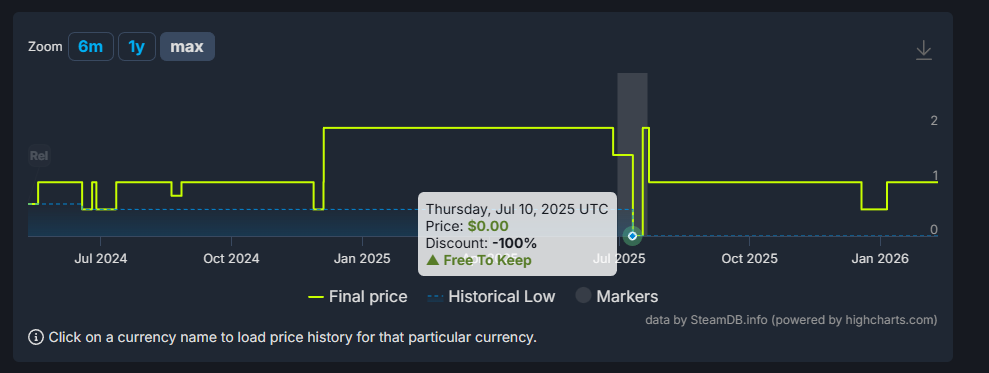
I honestly, don’t know how you do this. If you have, please email me. My hunch is you just use the Steamworks support tool and ask them to give you a free week. Maybe sometimes they say yes.
Here are the games that did it recently
| Game | Reviews as of February 2026 | Price | Coming soon page age at launch | Followers at launch | Genre |
| Rat Quest | 1474 (only 17 paid) | $4.99 | 14 days | 2 | Platformer |
| WHAT THE PAK?! | 1255 (only 48 paid) | $5.99 | 263 days | 3421 | Multiplayer party |
| Caribbean Crashers | 1337 (only 37 paid) | $0.99 | 30 days | 3 | Strategy |
| A Story About Farting | 1044 (only 29 paid) | $1.99 | 142 days | 22 | Narrative puzzle |
Note though that I don’t think the free week helped very much. Reviews that are left during the free week do not count towards the total. If you look at the steam page for these games they will show the paid for reviews, and omit the free reviews.
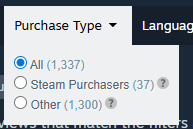
Here is the review count for Caribbean Crashers. Notice that even after going free and earning 1300 reviews, they are still sitting at 37 paid reviews. Going free didn’t help much for real sales.
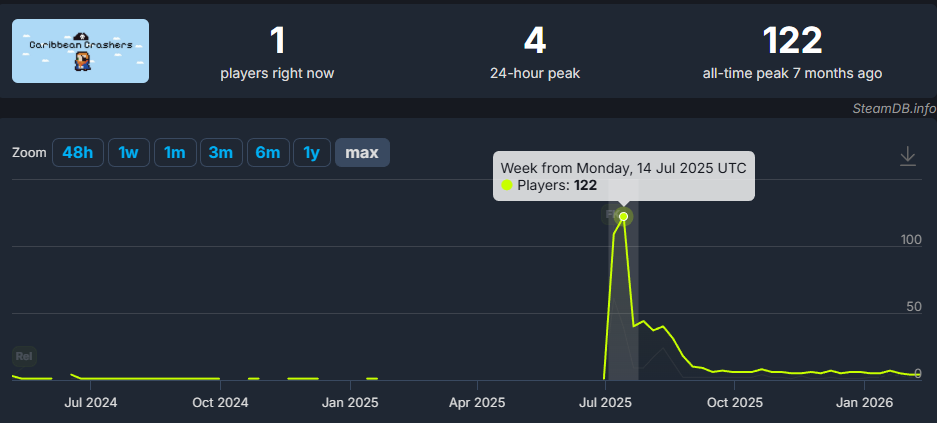
Also few people actually play the game. Here is their concurrent player count (CCU) during that week. It only spiked up to 122.
Also it absolutely destroys your rating. So many bad reviews were left like this one:
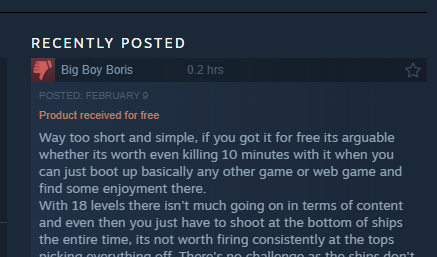
Steam players want a game that respects their time by filling it. They want LOOOOONG games.
Also you totally destroyed your “historic low” price. So if you are going to try this, only do it after you have reach historic lows of 50%, 60%, 70%, 75%, 80%, 90% etc.
How to replicate this
I really don’t think the free week trick helps your game. BUT, if you must here is what I would do it:
- Do every single historic low discount level before you do this.
- Use the free week when you are doing a big announcement like a new game.
- Make sure inside your free game you have a clear pop up that says “Wishlist our new game”
- Cover your free game’s Steam page with cross references to your new game.
Abnormal behavior
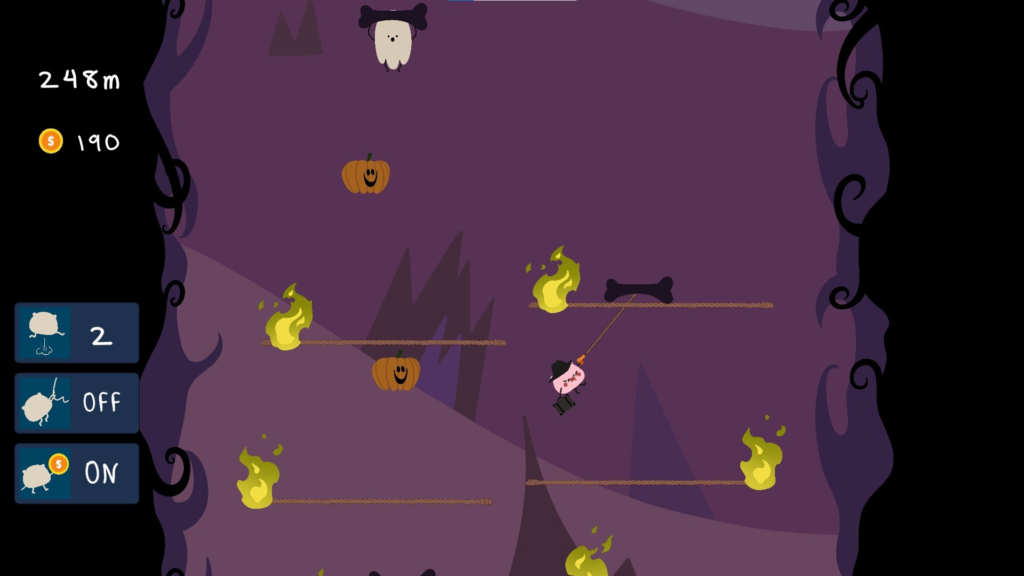
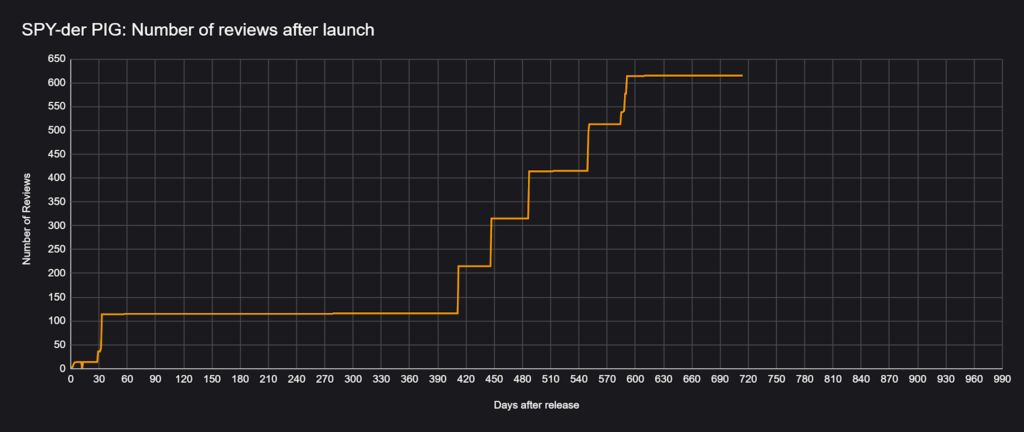
Amazingly I found SPY-der PIG which has the most efficient marketing I have ever seen.
This team has built such a dedicated community that they are able to get exactly 100 reviews every single month in a single day.
I can only assume they are using micro-targeting to pick 100 people from their community, giving them a very clear call to action that says “Today, review our game” and 100% of their targeted audience responds.
It really is amazing to see when marketing works as well as you expect it to.
Truly inspiring what the SPY-der pig team has done here
Also amazing that every single reviewer has played EXACTLY 4.6 hours on record:
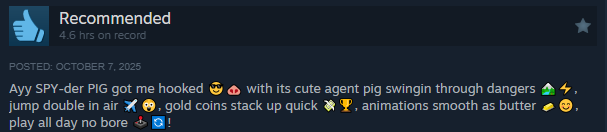
And

And
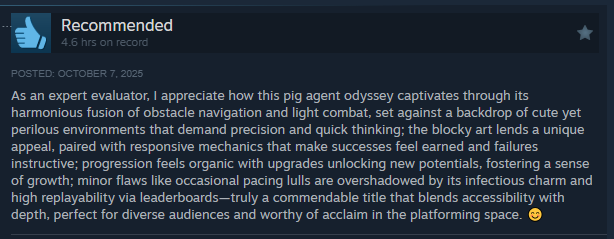
Truly inspiring masterclass in marketing done here.
But Valve said there are no black marks
If you watch Q&As with the Valve Steam team, they say that there are no black marks on games. Basically the algorithm doesn’t punish you for past behvior, it doesn’t care about low conversion rates, it only cares about raw dollars earned. If suddenly your game starts earning a ton of money, the algorithm doesn’t hold a grudge and will push you everywhere again.
Then why are there only 28 games that rose from the dead in 2024?
My theory is that visibility isn’t the limiting factor, game excitement is.
If you follow the core Steam marketing meta: at least 6 months coming soon, youtube trailer, some social media, demo, content creators, festivals, Steam Next Fest, your game is pretty well exposed.
Then hopefully at launch when you do Discovery Queue, Popular Upcoming, New & Trending your game is further exposed to so many different audiences and sub fandoms. If the game does’t take off from all of that, the game just didn’t excite the market. The Steam algorithm exposed your game a ton, and people just said “eh not for me.”
And don’t be fooled by the “mostly positive” rating. That is just survivorship bias. The people who don’t like your game won’t leave bad reviews, because they never bought it in the first place. I wrote about this in this blog post named When Mostly Positive Games Don’t Sell.
In the first 2 months of launch, the players and the algorithm know what they think about your game. But do you?
Summary what should you do?
If you had a rough launch and by the end of the first month, you are under 150 reviews. I am sorry, your game probably won’t reach “real steam.”
The odds are so incredibly slim, your time is best spent working on your next game.
INTERESTING FACT: The genres that came back from the dead were over-represented by some genres:
- 21% were Horror
- 14% were Friendslop (note some of these friendslop games were horror so they are part of that 21% horror above)
- 11% were Adult
These are only a few games that I would consider spending more time to turn things around
- Your “coming soon” page was only up for a few weeks (despite me warning you that you need it up for at least 6 months).
- You never put out a demo.
- Your game’s median play time is over 2.5 hours (this median play time is WAY OVER typical ranges and indicates that you have an exciting game)
- You are making a horror, Adult, or friendslop game (notice how many of the 28 were these three genres) These fans are voracious and they are always looking for hidden gems.
- You didn’t reach out to many content creators in the run up to your launch (fewer than 300 creators is what I consider as “not many”).
- Any content creator that did manage to find it loved it and played the game across multiple distinct streams (this indicates a true desire for the game, not just them being nice).
If you meet those criteria, do this:
- Patch your game for any bugs and add some tiny bit of additional content that you can call a “free content update.” But DON’T Ship it right away, instead…
- Spend one more month reaching out to as many content creators as you possibly can with that new patch in a beta branch.
- Wait for your next available discount window, and launch that patch.
- Discount your game 10% lower than your last discount price (a new historic low).
- Use an “update visibility round.”
- Pray
- Don’t panic and do the “Free to keep” trick, I still don’t think it is worth doing.
If you do this for 1 month and nothing comes of it, move on to your next game.
If you were doing this as a “middle game” or a practice game or you were trying to do a great conjunction game, that’s totally fine! Those games are supposed to be cheap, fast, and profit is not as important as learning how to release a game.